OpenAI for India: Infrastructure, Enterprise Adoption, and Workforce Scale
_<->1708724263995_9Y10OskXA8FdggLg.jpeg?w=3840&q=75)
Sarah J
Posted on Thu, Feb 19, 2026
Share the article with your network



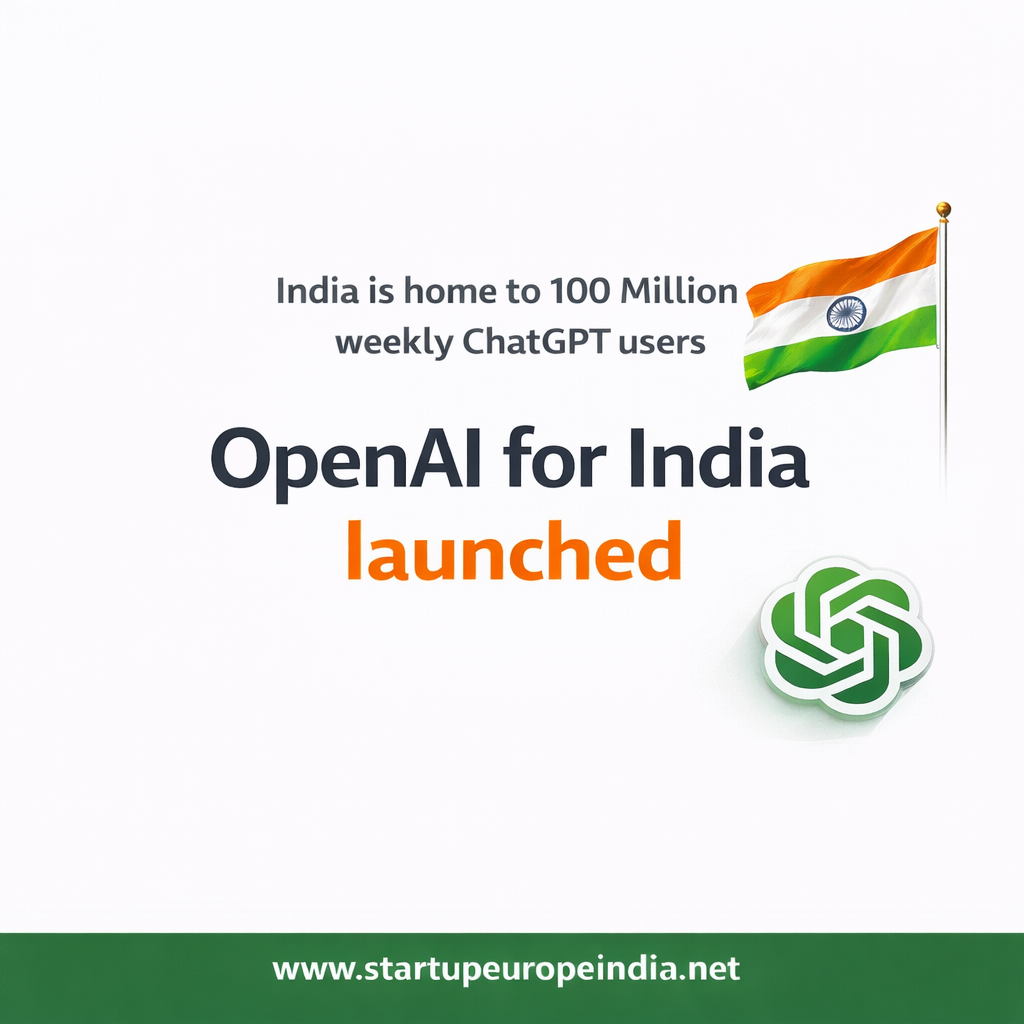
On 18 February 2026, at the India AI Impact Summit in Delhi, OpenAI announced OpenAI for India, a long-term programme built around local infrastructure, enterprise deployment, and workforce development. The initiative positions India not only as a large user base for AI tools, but as a strategic geography for infrastructure and institutional partnerships.
The announcement makes four commitments clear: build local AI-ready capacity, deepen enterprise integration, expand certifications and academic access, and grow on-the-ground operations in India.
Scale of usage
OpenAI stated that India now has more than 100 million weekly ChatGPT users. That scale alone explains why the company is formalising a structured programme rather than continuing with isolated commercial partnerships. India is already one of the largest markets for AI usage globally; the announcement recognises that reality and moves toward institutional integration.
Infrastructure: Data residency and capacity
A central element of the programme is a partnership with the Tata Group, specifically through Tata Consultancy Services (TCS).
OpenAI will become the first customer of TCS’s HyperVault data-centre business. The arrangement begins with 100 megawatts of AI-ready capacity, with the potential to scale to 1 gigawatt over time. The stated objectives are data residency, security, and reduced latency for mission-critical and government workloads.
This is operationally significant. On-shore data capacity addresses regulatory and enterprise concerns around cross-border data flows. Reduced latency matters for real-time AI applications. Dedicated AI-ready infrastructure signals that the company is not treating India as a peripheral deployment region, but as a primary infrastructure geography.
The reference to the global Stargate effort indicates that India is being folded into OpenAI’s broader data-centre expansion strategy rather than handled as a standalone market experiment.
Enterprise rollout: From pilot to institutional use
The programme also includes a strategic enterprise collaboration with the Tata ecosystem. OpenAI plans to deploy ChatGPT Enterprise across Tata employees, beginning with hundreds of thousands of TCS employees. The announcement also references the use of OpenAI’s Codex to support AI-native software development workflows.
For a services firm of TCS’s size, this represents a potential shift from experimental AI usage to standardised deployment. The scale of the employee base makes this one of the largest structured enterprise rollouts announced publicly.
The practical impact will depend on implementation details that have not yet been disclosed: governance frameworks, access controls, internal policy integration, measurement of productivity outcomes, and alignment with client confidentiality requirements. But the signal is clear — AI tools are being positioned as core enterprise infrastructure rather than optional add-ons.
Workforce and education: Certifications and access
The announcement extends beyond enterprise. OpenAI will expand its certification programmes in India, with TCS becoming the first participating organisation outside the United States for OpenAI Certifications.
In addition, OpenAI is providing 100,000 ChatGPT Edu licences to selected institutions, including:
- Indian Institute of Management Ahmedabad
- All India Institute of Medical Sciences, New Delhi
- Manipal Academy of Higher Education
- University of Petroleum and Energy Studies
- Pearl Academy
The institutions listed span management, medicine, engineering, and design. That breadth suggests a cross-disciplinary approach rather than limiting AI access to technical departments. The long-term question will be how these licences translate into curriculum integration, assessment standards, and employability outcomes.
Local presence: Expanding operations
OpenAI also plans to open offices in Mumbai and Bengaluru later in 2026, adding to its existing New Delhi presence. This reflects an intent to embed locally — in policy dialogue, enterprise partnerships, and developer ecosystems — rather than operate remotely.
Mumbai anchors finance and corporate headquarters. Bengaluru anchors technology and engineering talent. The geographic selection aligns with enterprise and developer priorities.
What this means in practical terms
Three structural implications emerge from the announcement:
First, infrastructure localisation is becoming non-negotiable. Data residency and sovereign compute capacity are increasingly prerequisites for large-scale AI adoption in regulated sectors. By committing to AI-ready capacity inside India, OpenAI is aligning with this requirement.
Second, enterprise adoption is moving from experimentation to standardisation. Deploying enterprise-grade AI tools across hundreds of thousands of employees signals institutionalisation. Whether productivity gains materialise will depend on execution, training, and governance.
Third, workforce capability is being treated as infrastructure. Certifications and university licences are not marketing gestures; they are part of ecosystem building. AI adoption at national scale requires trained users, not just APIs and data centres.
The announcement does not disclose commercial terms, pricing structures, data governance contracts, or deployment timelines. It does not specify how capacity will be phased or when the full 100 megawatts will be operational. These are reasonable areas for follow-up scrutiny.
However, the commitments that are public — infrastructure capacity, named institutional partnerships, enterprise deployment plans, and office expansion — are concrete and verifiable. The programme is framed as long-term rather than promotional.
India’s scale of AI usage, combined with its services-led technology economy, makes it a consequential market for AI providers. OpenAI for India reflects recognition of that fact. The programme now moves from announcement to execution — and its impact will ultimately be measured not by statements at a summit, but by how effectively infrastructure, enterprises, and institutions translate access into measurable outcomes.
---
Join the Startup Europe India Network — the network connecting Europe and India’s tech and science ecosystems to drive partnerships and scale innovation.
You may also like
Sarah J
Fri, May 22, 2026
Andhra Pradesh Is Competing With Tamil Nadu's Manufacturing With Faster Processing

Sarah J
Fri, May 22, 2026
GOOGLE I/O 2026: EVERYTHING ANNOUNCED, EXPLAINED

Sarah J
Fri, May 22, 2026
Indian Rupees Under Pressure - A Perfect Storm of Geopolitics and Weak Flows