PM Modi in Gothenburg: India and Sweden's Strategic Partnership, May 17, 2026
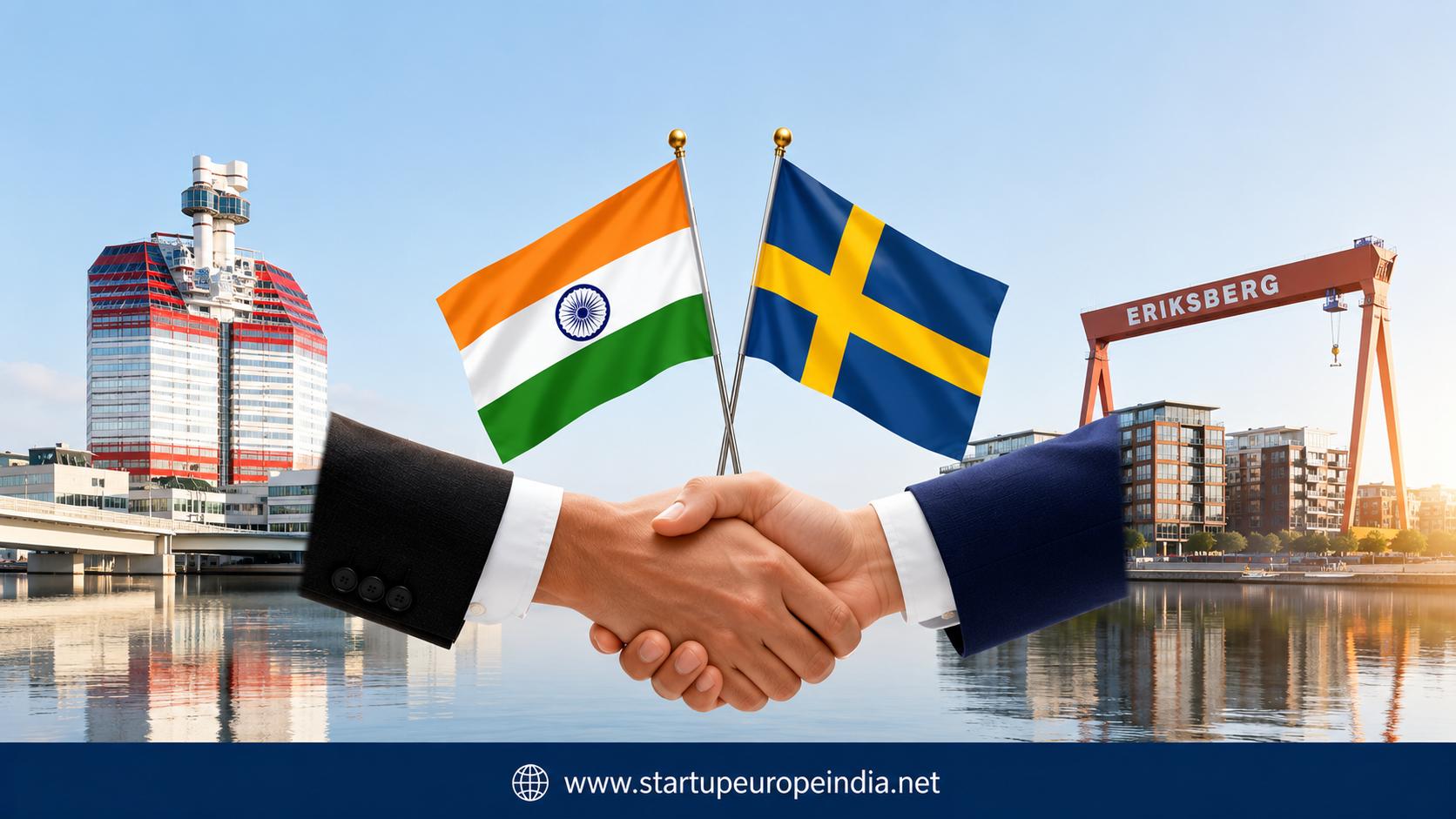
_<->1708724263995_9Y10OskXA8FdggLg.jpeg?w=3840&q=75)
Sarah J
Posted on Mon, May 18, 2026
Share the article with your network



Prime Minister Narendra Modi visited Gothenburg, Sweden on May 17, 2026, as the third stop of his five-nation European tour covering the UAE, Netherlands, Sweden, Norway, and Italy. It was his first visit to Sweden since 2018, when he attended the inaugural India-Nordic Summit.
Swedish Gripen fighter jets escorted Modi's aircraft as it entered Swedish airspace. Prime Minister Ulf Kristersson received him personally at Gothenburg Airport. Crown Princess Victoria of Sweden joined the bilateral meeting and conveyed the wishes of King Carl XVI Gustaf and Queen Silvia. Swedish Deputy Prime Minister Ebba Busch was also present.
Gothenburg was chosen deliberately. It is Sweden's second-largest city and the country's industrial and manufacturing heartland, home to Volvo Group, which hosted the evening's European Round Table for Industry CEO session. Holding a diplomatic summit in a manufacturing city rather than the capital carried an implicit message about where both governments want the partnership to operate.
Modi was conferred Sweden's Royal Order of the Polar Star Commander Grand Cross, the highest honour Sweden awards a foreign head of government. It was his 31st international honour from a foreign country. He was also presented with a symbolic gift: a box containing faithful reproductions of two handwritten cards by Rabindranath Tagore, India's Nobel laureate poet, chosen to reflect the historical depth of India-Sweden ties.
THE HEADLINE OUTCOME: STRATEGIC PARTNERSHIP
India and Sweden elevated their bilateral relationship to a Strategic Partnership, adopting the India-Sweden Joint Action Plan 2026-2030 as the implementation framework.
The partnership rests on four named pillars drawn directly from the official joint statement: Strategic Dialogue for Stability and Security; Next-Generation Economic Partnership; Emerging Technologies and Trusted Connectivity; and Shaping Tomorrow Together, covering people, planet, health, and resilience.
Both sides committed to doubling bilateral trade and investment within five years through the "Make in India" and "Made with Sweden" initiatives. Bilateral trade stood at $7.75 billion in 2025. A bilateral summit titled "India-Sweden: Stronger Together - towards 2047" was agreed to be held in India in 2027, anchoring the five-year roadmap at heads-of-government level.
Kristersson reiterated Sweden's support for India's permanent membership of a reformed and expanded UN Security Council.
TECHNOLOGY: THE FULL PICTURE
SWEDEN-INDIA TECHNOLOGY AND ARTIFICIAL INTELLIGENCE CORRIDOR (SITAC)
The Sweden-India Technology and Artificial Intelligence Corridor, named SITAC in the official joint statement, was formally agreed. Its scope covers AI, digital transformation, innovation, and advanced technology partnerships involving industry, startups, and research institutions from both countries.
The Swedish Deputy Prime Minister Ebba Busch attended the AI Impact Summit in New Delhi in February 2026 with a large delegation from the Swedish AI ecosystem. The joint statement records that Modi expressed appreciation for Sweden's participation. SITAC emerges directly from that engagement and gives it a bilateral institutional name and framework.
JOINT INNOVATION PARTNERSHIP 2.0 AND THE INDIA-SWEDEN JOINT SCIENCE AND TECHNOLOGY CENTRE
The Joint Innovation Partnership 2.0 was launched, upgrading the existing bilateral innovation framework. It establishes a virtual India-Sweden Joint Science and Technology Centre (ISJSTC) to connect academic institutions from both countries and facilitate joint R&D.
The named technology domains in the partnership are artificial intelligence, 6G, quantum computing, critical minerals, renewable energy, and smart grid technologies. The 6G inclusion is directly relevant to Ericsson, which is headquartered in Sweden and was present at the European Round Table alongside Nokia, Vodafone, and Orange. Any India-Sweden 6G cooperation framework draws Ericsson into its scope commercially, even without naming the company in the agreement.
SPACE: ISRO AND THE VENUS ORBITER MISSION
The most operationally specific deliverable of the entire visit was the MoU between ISRO and the Swedish Institute of Space Physics on the Indian Venus Orbiter Mission, formally named Shukrayaan.
The instrument Sweden will contribute is the Venusian Neutrals Analyzer (VNA), which will study how charged particles from the Sun interact with Venus's atmosphere and exosphere. The VNA is the ninth generation of the Swedish Institute of Space Physics's series of miniaturised ion and ENA (Energetic Neutral Atoms) instruments. The first generation, named SARA (Sub-keV Atom Reflecting Analyzer), flew on ISRO's Chandrayaan-1 in 2008-2009, making that the original basis of the ISRO-IRF collaboration. Sweden's Ambassador to India confirmed in September 2024 that ISRO and the Swedish Space Corporation were already working together on the mission; the Gothenburg MoU formalises that on official bilateral footing.
Shukrayaan's key dates: the Indian government formally approved the mission in September 2024. The launch is scheduled for March 29, 2028 from Sriharikota on a GSLV rocket, with a 112-day journey and orbital insertion around Venus on July 19, 2028. The preliminary design report for the spacecraft was completed in April 2026. The 100kg science payload includes 16 Indian instruments, 2 collaborative instruments, and an international payload. Sweden's VNA is among the confirmed international contributions.
Both leaders also agreed to pursue enhanced cooperation on space and geospatial technologies more broadly, noting India's role as a leading space nation and the role of Sweden's Esrange Space Center in Kiruna. Esrange is the northernmost satellite launch and space testing facility in Europe, capable of polar orbit launches and high-altitude balloon experiments, and one of a small number of facilities globally that can conduct certain types of re-entry testing.
Kristersson said at the joint press conference: "Sweden is proud to be on our way to Venus together with India. ISRO and Sweden's national space agency have joined forces since the 1980s."
LEAD-IT 3.0
Both Prime Ministers welcomed the expansion of the Leadership Group for Industry Transition (LeadIT) and called for a new four-year phase, LeadIT 3.0, to be announced at COP31. LeadIT is a Sweden-India co-chaired global initiative focused on accelerating the transition of heavy industry toward net-zero emissions. The India-Sweden Industry Transition Partnership (ITP), a bilateral mechanism under LeadIT, was also recognised. The ITP focuses on the steel and cement sectors specifically. Its steel working group is co-led by India's Ministry of Steel and the Swedish Energy Agency, with the Council on Energy, Environment and Water (CEEW) and Swerim (Swedish Research Institute for Mining, Metallurgy and Materials) as knowledge partners. Its cement working group is co-led by India's Department for Promotion of Industry and Internal Trade and the Swedish Energy Agency, with NCCBM (National Council for Cement and Building Materials) and RISE (Research Institutes of Sweden) as knowledge partners. Moving to LeadIT 3.0 signals that the programme is consolidating as a permanent mechanism, not a rotating initiative.
CRITICAL MINERALS
Both leaders encouraged collaboration in advanced mining and mineral processing technologies to facilitate efficient extraction from low-grade and complex critical mineral deposits, and committed to co-developing refining and downstream processing capabilities to enhance domestic value addition, with an explicit focus on rare earths supply chains.
Sweden holds some of Europe's largest rare earth mineral deposits, including the Kiruna iron ore field and Europe's largest identified deposit of rare earth elements discovered in northern Sweden in 2023 by state mining company LKAB, estimated at over one million tonnes of rare earth oxides. India's inclusion of Sweden as a critical minerals partner, alongside its separate critical minerals MoU with the Netherlands signed two days earlier, reflects a deliberate strategy of building diversified European supply chain relationships rather than a single bilateral dependency.
DEFENCE AND SECURITY
Both sides agreed to strengthen dialogue at the political, diplomatic, and defence levels, including direct exchanges between the National Security Advisors of both countries and their respective offices. A Defence Industrial Roadmap was agreed to be explored, with focus on potential joint manufacturing, technology transfer, and supply chain collaboration.
On counterterrorism, Modi thanked Kristersson for Sweden's support following the April 2025 Pahalgam attack in which 26 people were killed. Both leaders agreed on zero tolerance toward terrorism and called for action against those who back, finance, or provide safe havens for terrorist groups.
PEOPLE-TO-PEOPLE AND MOBILITY
Both leaders agreed to advance talent attraction and active promotion of people-to-people exchanges, specifically naming mobility of students and researchers through the Study in Sweden programme and highly skilled labour through the Work in Sweden programme. Both leaders also agreed to explore the possibility of direct and regular air links between Sweden and India, noting that no direct flight route currently exists between the two countries despite the depth of bilateral economic ties.
THE EUROPEAN ROUND TABLE FOR INDUSTRY
The CEO-level session at Volvo Group in Gothenburg on the evening of May 17 was co-hosted by Modi, Kristersson, and European Commission President Ursula von der Leyen. It was one of the most significant India-Europe business engagements in recent years.
Companies present covered five sectors. Telecom and digital: Vodafone, Ericsson, Nokia, and Orange. Technology and semiconductors: ASML, NXP, SAP, and Capgemini. Energy and clean tech: ENGIE, TotalEnergies, Shell, and Umicore. Infrastructure, mobility, and manufacturing: Volvo Group, Maersk, Airbus, Saab, ArcelorMittal, and Heidelberg. Healthcare and life sciences: AstraZeneca, Roche, Merck, Philips, Nestle, and Unilever.
Modi asked each company present to make one new, bold, concrete commitment to India within the next five years. He framed the ask around five priority sectors: telecom and digital infrastructure covering the 5G to 6G transition and AI-enabled networks; electronics and deep tech manufacturing; green energy and green hydrogen; infrastructure, mobility, and urban transformation; and healthcare and life sciences.
Modi also proposed four institutional mechanisms to anchor the India-Europe business relationship on a sustained basis: an annual India-Europe CEO Roundtable involving industry bodies from both sides; sector-specific working groups to fast-track collaboration in priority areas; an ERT India Desk or India Action Group to support companies already in India and facilitate new entrants; and government-backed investment facilitation to reduce friction for European firms entering Indian markets.
Von der Leyen described the India-EU Free Trade Agreement concluded in January 2026 as the "mother of all deals" and said the FTA is estimated to create 23,000 new jobs in Sweden, with more than 6,000 in the Gothenburg region. She expressed confidence in a "dynamic new era" in EU-India relations. Modi said: "We are trying to implement this as soon as possible."
Modi also separately met Robert Maersk Uggla, Chairman of Maersk, and discussed Maersk's investment opportunities in Indian port infrastructure and logistics.
INDIA-SWEDEN SME AND STARTUP PLATFORM
Both sides decided to develop an India-Sweden SME and Startup Platform to support innovation ecosystems in both countries and generate employment. This directly connects Sweden's deep technology startup ecosystem, particularly in Gothenburg and Stockholm, with India's manufacturing and digital scale.
GEOPOLITICAL FRAMING
Both sides underlined the importance of an effective multilateral system with the UN at its core. Both called for a comprehensive, just, and lasting peace in Ukraine through diplomacy and dialogue in line with the UN Charter. The India-Nordic Summit in Oslo on May 19, 2026, with the leaders of Norway, Sweden, Denmark, Finland, and Iceland, was confirmed as the next stage of regional engagement.
WHAT THE OFFICIAL SWEDISH GOVERNMENT PRESS RELEASE ADDS
The Swedish government's own press release, issued by Prime Minister Kristersson and Foreign Minister Maria Malmer Stenergard, characterised the partnership as deepening cooperation in "innovation, technology and green transition" and stressed the intensified focus on "economic security, supply chains, cyber issues and counterterrorism." The framing from the Swedish side emphasises security of supply chains as a standalone priority, not just a technology or trade issue. This reflects Sweden's position as a NATO member that joined the alliance in March 2024 and now approaches economic partnerships through a more explicit security lens than it did before.
Kristersson's statement: "Sweden and India share a partnership shaped by more than a century of cooperation, trust and entrepreneurship. I am confident that our cooperation will continue to grow through innovation, sustainability and digital transformation."
WHAT SET THIS APART FROM THE NETHERLANDS VISIT
The Netherlands visit produced 17 signed agreements across a broad range of sectors. The Sweden visit was more concentrated, with fewer documents but more depth in specific technology areas. Three things from Gothenburg that received insufficient coverage:
First, SITAC, the Sweden-India Technology and Artificial Intelligence Corridor, is the only bilaterally named AI corridor India has established with a European country to date. Its formal naming in the joint statement, and not just as a rhetorical ambition but as a structured cooperation framework, is more significant than the coverage suggested.
Second, the Venus Orbiter MoU is the most operationally concrete science agreement from Modi's entire five-nation tour. It connects two space agencies with a 40-year working history, on a defined mission with a fixed launch date (March 29, 2028), a specific instrument (VNA), and a known spacecraft design (preliminary design report completed April 2026). It is not a framework for future cooperation; it is a confirmed instrument on a confirmed mission.
Third, the critical minerals cooperation with Sweden, specifically on rare earth extraction and refining, sits alongside Sweden's underdiscussed position as the holder of Europe's largest identified rare earth deposit. The LKAB rare earths discovery in northern Sweden, estimated at over one million tonnes of rare earth oxides, is directly relevant to semiconductor and battery supply chains. India's engagement with Sweden on advanced mining and downstream processing is not separate from its semiconductor ambitions; it is part of the same supply chain logic.
You may also like
Sarah J
Wed, May 27, 2026
The European Commission's New Merger Guidelines: What Has Changed and Why It Matters

Sarah J
Fri, May 22, 2026
Andhra Pradesh Is Competing With Tamil Nadu's Manufacturing With Faster Processing
Sarah J
Fri, May 22, 2026
GOOGLE I/O 2026: EVERYTHING ANNOUNCED, EXPLAINED