Fri, May 22, 2026

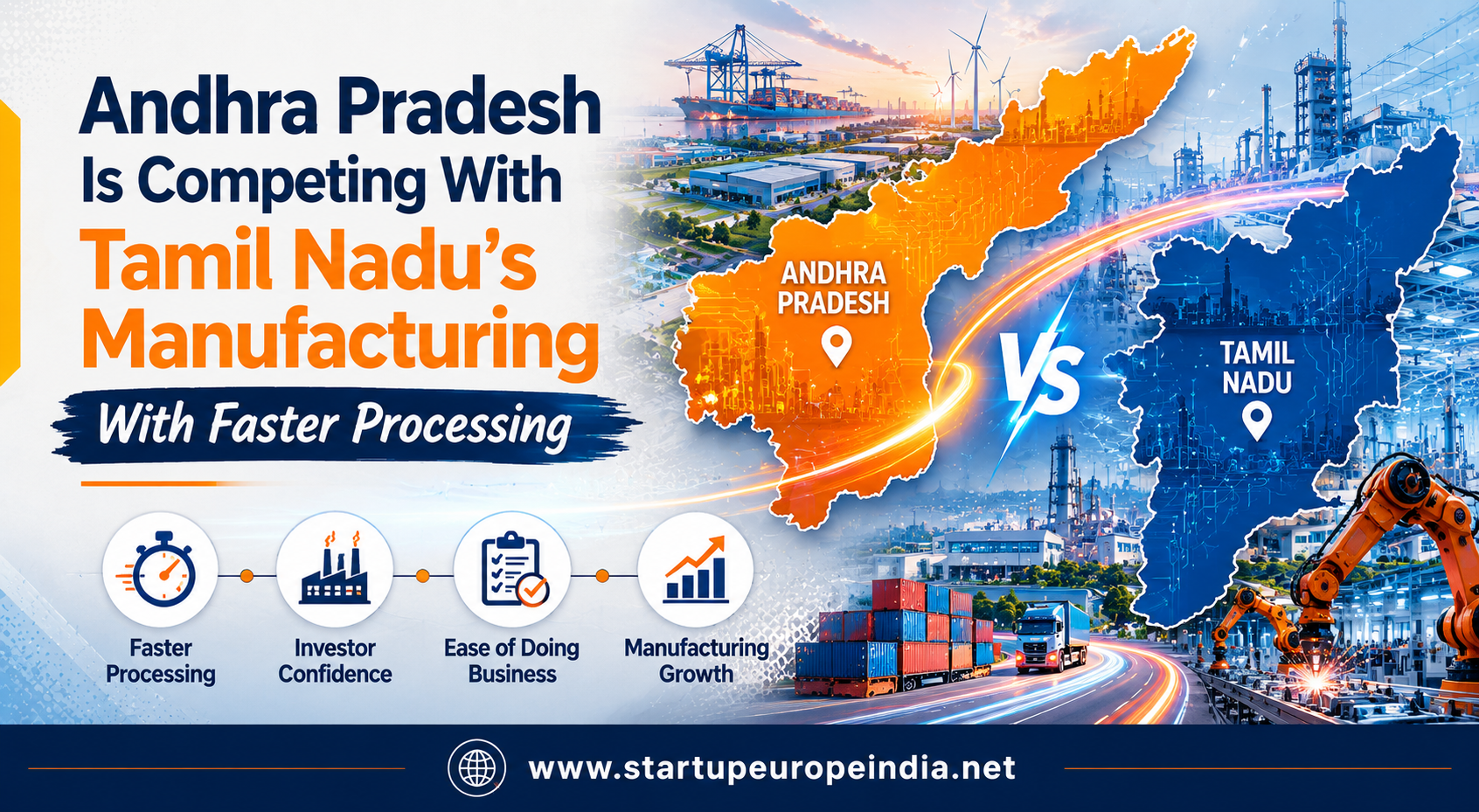
Andhra Pradesh Is Taking Tamil Nadu's Lunch

India
Sarah   J

Sarah J

Posted on Fri, May 22, 2026

5 min read

Share the article with your network

x
Facebook
linkedin

May 2026

A pattern has become too consistent to ignore. Project after project that Tamil Nadu expected, or in some cases had already signed, is ending up in Andhra Pradesh. Royal Enfield, Google, Hwaseung, the AMCA defence hub. The list is long enough now that it reflects something structural, not a run of bad luck.

Royal Enfield: First Move Outside Tamil Nadu in 70 Years

Royal Enfield's decision to build its first factory outside Tamil Nadu since 1955 is the most symbolically loaded shift so far. Eicher Motors, which owns the brand, has committed Rs 2,200 crore to a new manufacturing plant and vendor park at Satyavedu in Tirupati district. The Andhra Pradesh State Investment Promotion Board cleared the proposal on May 6, 2026.

The numbers are significant. Royal Enfield currently runs at around 14.6 lakh units of annual production capacity, near full utilisation. The Satyavedu facility will add 9 lakh units across two phases, phase one by 2029 and phase two by 2032, taking total capacity to roughly 23.6 lakh units. Around 5,000 direct and indirect jobs are expected, and the state government has allocated 276 acres across Vanelluru and Rallakuppam villages in Satyavedu mandal.

Royal Enfield has officially called this an expansion rather than a relocation, and that is fair. The company also approved a separate Rs 958 crore brownfield expansion at its Cheyyar plant in Tamil Nadu, which will take its TN capacity to 20 lakh units by FY2028. But the geography of the Satyavedu choice is telling. The site sits barely 15 km inside the Andhra Pradesh border, close enough to retain access to the Hosur-Oragadam supplier belt that powers Tamil Nadu's automotive ecosystem. The facility also has an inland container depot on-site, allowing Royal Enfield to containerise motorcycles at the factory gate and move them by rail to whichever port offers the best berth availability, cutting out the truck queues and congestion out of Chennai. In short, the company found a site that gives it most of what Tamil Nadu offers, plus land, logistics flexibility, and a government that moved fast.

Google: A $15 Billion Investment That Went to Visakhapatnam

In October 2025, Google announced a $15 billion AI and data centre hub in Visakhapatnam, its largest single infrastructure commitment in India. The project spans three linked campuses covering over 320 acres, with a planned capacity of 1 gigawatt. It is being developed with AdaniConneX and Bharti Airtel, including co-investment in renewable energy, transmission lines, and storage systems. The project is expected to create between 5,000 and 6,000 direct jobs and between 20,000 and 30,000 total jobs in the state.

Chennai is a traditional data centre hub with multiple submarine cable landings, which made it a natural candidate. Tamil Nadu opposition party AIADMK publicly accused the DMK state government of failing to engage Google, noting that Alphabet CEO Sundar Pichai has roots in Tamil Nadu. When asked about the political noise, Andhra Pradesh IT minister Nara Lokesh offered three words: "He chose Bharat."

What Andhra Pradesh offered was a comprehensive incentive package estimated at around Rs 22,000 crore in value, including land subsidies, water tariff subsidies, state GST reimbursement, and power concessions, as well as 480 acres in Visakhapatnam. Karnataka's IT minister Priyank Kharge called the package an "economic disaster." Andhra Pradesh called it a game changer.

Hwaseung: Signed With Tamil Nadu, Built in Andhra Pradesh

South Korean manufacturer Hwaseung, which supplies Adidas and Reebok, signed an MoU with the Tamil Nadu government in August 2025 for a Rs 1,720 crore non-leather footwear facility in Thoothkudi. It was to be the company's first production base in India. Within three months, Hwaseung had shifted the project to Kuppam in Andhra Pradesh.

The company was direct about why. Its footwear division CEO Bob Shorrock said the company had worked closely with Tamil Nadu's investment agency and with Andhra Pradesh's Economic Development Board and concluded that AP was the right location. Andhra Pradesh allotted 100 acres in Kuppam. The facility is expected to produce 20 million pairs of sports shoes annually and employ around 20,000 people across three phases. Kuppam, incidentally, is Chandrababu Naidu's own constituency.

AMCA: A Rs 15,000 Crore Defence Hub Tamil Nadu Was Actively Pursuing

The AMCA case is the most pointed. The Advanced Medium Combat Aircraft flight testing and integration complex is tied to India's fifth-generation stealth fighter programme, with an estimated project value of Rs 15,000 crore. Tamil Nadu had lobbied hard for Hosur, offering 100 acres of land at no cost and pointing to the 3.5 km runway at Hosur airport as a logistical advantage. Defence Minister Rajnath Singh and Chief Minister Chandrababu Naidu laid the foundation stone in Puttaparthi, Andhra Pradesh.

The Structural Reasons

Across these cases, a consistent set of factors explains why Andhra Pradesh is winning. Land is the most immediate one. Tamil Nadu's industrial clusters around Chennai, Oragadam, and Hosur are mature and land-constrained. Andhra Pradesh has large tracts available through APIIC and has shown it can allot hundreds of acres quickly. The Royal Enfield clearance took weeks. In the Premier Energies solar facility case, where a Rs 5,942 crore plant moved from Telangana to Andhra Pradesh's Naidupeta, Naidu's government went from initial talks in October 2024 to land allotment by February 2025, four months.

The second factor is incentives. Andhra Pradesh is offering packages that rival states have called reckless, covering land, power, water, and tax reimbursements simultaneously. Karnataka and Tamil Nadu both have stronger fiscal positions than Andhra Pradesh, and both have argued that AP is mortgaging its balance sheet to win headline numbers. That critique may prove correct over time. Andhra Pradesh had the highest revenue deficit in the country in 2022-23. But in the competition for investment announcements, the incentive packages are working.

The third factor is political. Chandrababu Naidu has personal relationships at the central government level and has used them to steer defence and technology projects toward Andhra Pradesh. The AMCA project going to Puttaparthi over Hosur, despite Tamil Nadu's infrastructure offer, is the clearest example.

Tamil Nadu's counterargument is not without substance. The state has become the primary hub for Apple manufacturing in India, with Foxconn, Pegatron, and Tata Electronics all operating there. Chennai remains one of India's leading destinations for global capability centres. The state has a mature industrial ecosystem, skilled labour, and port infrastructure that no incentive package can replicate overnight.

But the deal flow over the past eighteen months shows that maturity alone is no longer enough. In a period when India's manufacturing ambitions are expanding faster than any single state's available land, companies are looking wherever the combination of logistics access, speed of clearance, and cost of land meets their threshold. Andhra Pradesh, under Naidu, has worked hard to be that answer. Tamil Nadu, under the current DMK administration, has repeatedly found that it was not.

---

Startup Europe India Network is a curated Europe–India–UK platform for technology and science leaders, enabling cross-border collaboration, strategic partnerships, intelligence sharing, and scaling across deep tech and innovation sectors. Get access www.startupeuropeindia.net

You may also like

Sarah   J

Sarah J

Fri, May 22, 2026

GOOGLE I/O 2026: EVERYTHING ANNOUNCED, EXPLAINED

GEMINI 3.5 FLASHGoogle's newest and fastest AI model. Despite being in the "Flash" (cheaper/faster) tier, it outperforms Gemini 3.1 Pro on coding and agentic benchmarks. That's a meaningful inversion: the cheaper model is now beating the premium one on the tasks developers actually use AI for.Runs behind most of Google's new products announced at I/O. Also available directly to developers building their own apps and tools. Who gets it: Everyone. Available now for Google AI Plus, Pro, and Ultra subscribers. Developer pricing: $1.50 per million input tokens, $9.00 per million output tokens, roughly 40% cheaper than Gemini 3.1 Pro. Consumer pricing: Included in all paid plans from $7.99/month.GEMINI 3.5 PROThe full-power version of the 3.5 model family, above Flash in capability.Heavy reasoning, research, complex multi-step tasks where you need the strongest model, not the fastest. Who gets it: Not yet available. Sundar Pichai said it would arrive next month. Pricing: Not yet disclosed.GEMINI OMNI FLASHA multimodal model that works across text, images, video, audio, and other input types in one unified system. You can feed it basically anything and have a conversation about it.Editing a video by talking to it, analysing a document you photographed, creating visuals from voice descriptions.Available now for Google AI Plus, Pro, and Ultra subscribers. Pricing: Included in all paid plans.GEMINI SPARKA 24/7 personal AI agent that runs on Google's cloud servers, not on your device. It keeps running even after you close your laptop or lock your phone. It monitors your Gmail, manages your Calendar, and drafts documents in Google Docs without you being actively present.Set recurring tasks like automatically parsing monthly credit card statements to flag subscription fees. Teach it to check your inbox for school updates from your kids and send a daily digest. Ask it to synthesise raw meeting notes from emails and chats, create a polished Google Doc, and draft the follow-up email. You can also teach it custom skills for specific workflows.Rolling out to trusted testers now, with beta access going to US Google AI Ultra subscribers next week. Pricing: Included in the AI Ultra plan ($100/month). Asks your permission before taking high-stakes actions like sending emails or spending money.DAILY BRIEFA lighter version of agentic Gemini that does not run 24/7 but delivers a morning summary. It gathers urgent updates from your Gmail inbox, tracks upcoming events from your Calendar, and compiles relevant follow-up details into a skimmable briefing. It actively organises and prioritises based on your specific goals, even suggesting immediate next steps.Start your day without digging through your inbox. Get a prioritised to-do list generated automatically.Rolling out now to Google AI Plus, Pro, and Ultra subscribers in the US. Pricing: Included in all paid plans from $7.99/month.AI-POWERED SEARCH BOXThe Google Search box has been rebuilt around Gemini. It now supports images, files, videos, and Chrome tabs as inputs alongside text, and is designed to better anticipate intent and help users form questions. Think of it as Search evolving from keyword lookup to a conversation. Paste a screenshot of a product, ask a multi-sentence question in plain English, attach a file and ask questions about it, all directly in the search box.Deploying now in all languages and countries where AI Mode is available. Pricing: Free.ASK YOUTUBEA Gemini-powered feature built into YouTube that lets users ask questions about videos, with support for context and follow-up questions. Instead of scrubbing through a video to find the answer to a specific question, you ask and it finds it."What supplement did they mention at the 12 minute mark?" or "Summarise the arguments in this debate." Particularly useful for long-form content, tutorials, and educational videos. Currently in testing, rolling out broadly in the US this summer. Pricing: Not yet confirmed, likely tied to paid plans.UNIVERSAL CARTA single shopping cart that follows you across Google Search, Gemini, YouTube, and Gmail. The moment you add a product, it works in the background to find deals, track price history, alert you to price drops, and flag stock availability. It also flags product incompatibilities, for example warning you that a motherboard and processor you added are not compatible.You see a product mentioned in a YouTube video, add it to your cart without leaving YouTube, and the cart automatically tracks it for a week until it goes on sale.Rolling out across Search and the Gemini app this summer, with YouTube and Gmail to follow. Pricing: Free, built on Google Wallet.ANDROID HALOA persistent visual indicator at the top of your Android screen that shows what AI agents are actively doing in the background at any given moment. As agents become capable of running tasks independently, this tells you what they are doing without you having to check.Glance at the top of your phone and see that Gemini Spark is drafting your meeting recap or that an agent finished booking a restaurant. Oversight without micromanagement.Coming with Android 17 later this year. Pricing: Free, part of Android 17.GOOGLE PICSA new image creation and editing tool inside Google Workspace, similar to Canva, for building posters, flyers, and infographics. It treats every element as an individual object rather than a flat image, so you can swap or edit specific details without redoing the whole thing. All output is watermarked with SynthID.A small business owner creates a promotional flyer by describing it in plain text. A marketing team edits individual elements of a graphic without going back to a designer.Rolling out this summer to Google AI Pro and Ultra subscribers. Pricing: Included in Pro ($19.99/month) and Ultra ($100/month).STITCHGoogle's design tool for building apps and websites, updated with real-time collaborative design via Stitch Agent. Now includes exports to Antigravity and direct publishing to Netlify.A team designs a web app together in real time, then publishes it directly without switching tools.Available now for developers. Pricing: Not separately disclosed.GOOGLE FLOWGoogle's creative studio for video and media work, now updated with Gemini Omni and multi-action AI agents. Includes custom tools via Flow Tools.Filmmakers and content creators running multi-step production workflows, like generating footage, editing, and scoring, with agents handling parallel tasks simultaneously.New features available now. Pricing: Not separately disclosed.ANDROID XR GLASSES (SAMSUNG, WARBY PARKER, GENTLE MONSTER)Audio glasses that provide all-day Gemini access with responses spoken privately into the wearer's ear. Can take photos, play music, handle calls, and access apps. Compatible with both Android and iOS.Hands-free translation when travelling, getting directions without looking at your phone, receiving a briefing spoken in your ear before a meeting.Launching this fall. Pricing and full specifications still to be confirmed.XREAL PROJECT AURADisplay glasses with actual OLED lenses, not just audio. Powered by a Qualcomm Snapdragon processor and capable of a 70-degree field of view. These show information visually overlaid in your field of vision.See real-time directions overlaid on the street in front of you, read a translation of a menu without looking down at your phone. Who gets it: Shown at I/O, no release date or pricing confirmed yet.GOOGLE ANTIGRAVITY 2.0Google's developer platform for building AI agents. Rebuilt to be agent-first, meaning it is designed from the ground up for apps that do things autonomously, not just apps that answer questions.Developers building tools that automate workflows, run tasks overnight, connect to APIs, and manage multi-step processes without user input at each step.CLI, SDK, and Native Voice Support available globally from May 19. Pricing: Free via Google AI Studio.SUBSCRIPTION PRICING (UPDATED)AI Plus: $7.99/month. Includes Gemini 3.5 Flash, the Gemini app with Omni, and Daily Brief.AI Pro: $19.99/month. Higher usage limits, more storage, Google Workspace integration, Google Pics later this summer.AI Ultra: $100/month (was $250). Includes 5x higher usage limits than Pro, 20TB cloud storage, YouTube Premium, and Gemini Spark beta access starting next week for US subscribers.Google is also replacing daily prompt limits with a compute-used model, where a simple text message costs less of your monthly allowance than a complex video editing or coding request. You pay proportionally to how much you actually use.Here is the complete I/O videoStartup Europe India Network is a curated Europe–India–UK platform for technology and science leaders, enabling cross-border collaboration, strategic partnerships, intelligence sharing, and scaling across deep tech and innovation sectors. Get access www.startupeuropeindia.net
Fri, May 22, 2026
GOOGLE I/O 2026: EVERYTHING ANNOUNCED, EXPLAINED
Sarah   J

Sarah J

Fri, May 22, 2026

Indian Rupees Under Pressure - A Perfect Storm of Geopolitics and Weak Flows
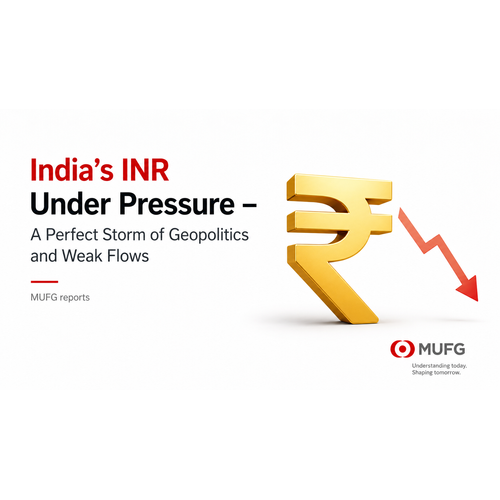
MUFG argues the Indian Rupee is vulnerable across multiple scenarios, with the immediate trigger being tension over the Strait of Hormuz. The note sees USD/INR moving toward 98.00 and even 100.00 if the Iran conflict prolongs, and forecasts the RBI hiking rates by 50bps to 5.75%, with risk scenarios reaching 6.25%–6.75%. Crucially, the bank's core thesis is that the weakness is structural, not just geopolitical - a problem of weak capital inflows that predates the conflict and will persist even if tensions ease.The key learnings:The driver mix is broader than oil. INR underperformance is driven by a combination of weak capital inflows, a wider current account deficit with higher oil prices, and potential energy supply disruption from a prolonged conflict. On top of that, a possible weak Southwest Monsoon, a "Super El-Nino," and uncertainty around further increases in US yields add meaningful left-tail risks.The flows problem is structural and predates the crisis. This problem of weak capital inflows into India predates the Iran conflict and is likely to continue even with de-escalation - and MUFG notes that more participants, including the RBI and government, are now recognizing the underlying shift in India's balance of payments.Rate hikes are framed as currency defense, not just inflation control. The forecast is for the RBI to hike at least 50bps this fiscal year to a 5.75% terminal repo rate, partly as a measure to shore up INR by raising relative rates of return while managing inflation expectations, with the hikes penciled in for the June and August meetings.Markets have already priced in significant risk premium. More than 125bps of RBI rate hikes are already priced over the next 12 months, and 12-month USD/INR forwards are a touch below 100. Despite that, MUFG still favors buying dips in USD/INR and recommends staying patient rather than chasing levels excessively.Authorities are intervening, but with side effects. Steps already taken include gradually raising domestic fuel prices, increasing gold import duties, restricting silver imports, introducing some work-from-home measures, and tightening scrutiny of the INR NDF market. The lesson here is that intervention isn't free — the NDF restrictions had unintended negative spillovers on foreign bond investor sentiment as hedging costs spiked. Looking ahead, MUFG expects further fuel hikes, tightening of the Liberalised Remittance Scheme, lower caps on Indian companies' overseas direct investment, and foreign-currency bond issuance to tap Non-Resident Indian funds.The deepest takeaway: policy tweaks alone won't fix it. For these measures to have a durable impact on supporting INR, ease of doing business in India must be improved and ultimately improve long-term earnings prospects relative to other markets. In other words, the currency problem is a competitiveness-and-returns problem in disguise.Complete report here: https://www.mufgresearch.com/fx/india-a-perfect-storm-22-may-2026/Startup Europe India Network is a curated Europe–India–UK platform for technology and science leaders, enabling cross-border collaboration, strategic partnerships, intelligence sharing, and scaling across deep tech and innovation sectors. Get access www.startupeuropeindia.net
Fri, May 22, 2026
Indian Rupees Under Pressure - A Perfect Storm of Geopolitics and Weak Flows
Sarah   J

Sarah J

Mon, May 18, 2026

PM Modi in Gothenburg: India and Sweden's Strategic Partnership, May 17, 2026

Prime Minister Narendra Modi visited Gothenburg, Sweden on May 17, 2026, as the third stop of his five-nation European tour covering the UAE, Netherlands, Sweden, Norway, and Italy. It was his first visit to Sweden since 2018, when he attended the inaugural India-Nordic Summit.Swedish Gripen fighter jets escorted Modi's aircraft as it entered Swedish airspace. Prime Minister Ulf Kristersson received him personally at Gothenburg Airport. Crown Princess Victoria of Sweden joined the bilateral meeting and conveyed the wishes of King Carl XVI Gustaf and Queen Silvia. Swedish Deputy Prime Minister Ebba Busch was also present.Gothenburg was chosen deliberately. It is Sweden's second-largest city and the country's industrial and manufacturing heartland, home to Volvo Group, which hosted the evening's European Round Table for Industry CEO session. Holding a diplomatic summit in a manufacturing city rather than the capital carried an implicit message about where both governments want the partnership to operate.Modi was conferred Sweden's Royal Order of the Polar Star Commander Grand Cross, the highest honour Sweden awards a foreign head of government. It was his 31st international honour from a foreign country. He was also presented with a symbolic gift: a box containing faithful reproductions of two handwritten cards by Rabindranath Tagore, India's Nobel laureate poet, chosen to reflect the historical depth of India-Sweden ties.THE HEADLINE OUTCOME: STRATEGIC PARTNERSHIPIndia and Sweden elevated their bilateral relationship to a Strategic Partnership, adopting the India-Sweden Joint Action Plan 2026-2030 as the implementation framework.The partnership rests on four named pillars drawn directly from the official joint statement: Strategic Dialogue for Stability and Security; Next-Generation Economic Partnership; Emerging Technologies and Trusted Connectivity; and Shaping Tomorrow Together, covering people, planet, health, and resilience.Both sides committed to doubling bilateral trade and investment within five years through the "Make in India" and "Made with Sweden" initiatives. Bilateral trade stood at $7.75 billion in 2025. A bilateral summit titled "India-Sweden: Stronger Together - towards 2047" was agreed to be held in India in 2027, anchoring the five-year roadmap at heads-of-government level.Kristersson reiterated Sweden's support for India's permanent membership of a reformed and expanded UN Security Council.TECHNOLOGY: THE FULL PICTURESWEDEN-INDIA TECHNOLOGY AND ARTIFICIAL INTELLIGENCE CORRIDOR (SITAC)The Sweden-India Technology and Artificial Intelligence Corridor, named SITAC in the official joint statement, was formally agreed. Its scope covers AI, digital transformation, innovation, and advanced technology partnerships involving industry, startups, and research institutions from both countries.The Swedish Deputy Prime Minister Ebba Busch attended the AI Impact Summit in New Delhi in February 2026 with a large delegation from the Swedish AI ecosystem. The joint statement records that Modi expressed appreciation for Sweden's participation. SITAC emerges directly from that engagement and gives it a bilateral institutional name and framework.JOINT INNOVATION PARTNERSHIP 2.0 AND THE INDIA-SWEDEN JOINT SCIENCE AND TECHNOLOGY CENTREThe Joint Innovation Partnership 2.0 was launched, upgrading the existing bilateral innovation framework. It establishes a virtual India-Sweden Joint Science and Technology Centre (ISJSTC) to connect academic institutions from both countries and facilitate joint R&D.The named technology domains in the partnership are artificial intelligence, 6G, quantum computing, critical minerals, renewable energy, and smart grid technologies. The 6G inclusion is directly relevant to Ericsson, which is headquartered in Sweden and was present at the European Round Table alongside Nokia, Vodafone, and Orange. Any India-Sweden 6G cooperation framework draws Ericsson into its scope commercially, even without naming the company in the agreement.SPACE: ISRO AND THE VENUS ORBITER MISSIONThe most operationally specific deliverable of the entire visit was the MoU between ISRO and the Swedish Institute of Space Physics on the Indian Venus Orbiter Mission, formally named Shukrayaan.The instrument Sweden will contribute is the Venusian Neutrals Analyzer (VNA), which will study how charged particles from the Sun interact with Venus's atmosphere and exosphere. The VNA is the ninth generation of the Swedish Institute of Space Physics's series of miniaturised ion and ENA (Energetic Neutral Atoms) instruments. The first generation, named SARA (Sub-keV Atom Reflecting Analyzer), flew on ISRO's Chandrayaan-1 in 2008-2009, making that the original basis of the ISRO-IRF collaboration. Sweden's Ambassador to India confirmed in September 2024 that ISRO and the Swedish Space Corporation were already working together on the mission; the Gothenburg MoU formalises that on official bilateral footing.Shukrayaan's key dates: the Indian government formally approved the mission in September 2024. The launch is scheduled for March 29, 2028 from Sriharikota on a GSLV rocket, with a 112-day journey and orbital insertion around Venus on July 19, 2028. The preliminary design report for the spacecraft was completed in April 2026. The 100kg science payload includes 16 Indian instruments, 2 collaborative instruments, and an international payload. Sweden's VNA is among the confirmed international contributions.Both leaders also agreed to pursue enhanced cooperation on space and geospatial technologies more broadly, noting India's role as a leading space nation and the role of Sweden's Esrange Space Center in Kiruna. Esrange is the northernmost satellite launch and space testing facility in Europe, capable of polar orbit launches and high-altitude balloon experiments, and one of a small number of facilities globally that can conduct certain types of re-entry testing.Kristersson said at the joint press conference: "Sweden is proud to be on our way to Venus together with India. ISRO and Sweden's national space agency have joined forces since the 1980s."LEAD-IT 3.0Both Prime Ministers welcomed the expansion of the Leadership Group for Industry Transition (LeadIT) and called for a new four-year phase, LeadIT 3.0, to be announced at COP31. LeadIT is a Sweden-India co-chaired global initiative focused on accelerating the transition of heavy industry toward net-zero emissions. The India-Sweden Industry Transition Partnership (ITP), a bilateral mechanism under LeadIT, was also recognised. The ITP focuses on the steel and cement sectors specifically. Its steel working group is co-led by India's Ministry of Steel and the Swedish Energy Agency, with the Council on Energy, Environment and Water (CEEW) and Swerim (Swedish Research Institute for Mining, Metallurgy and Materials) as knowledge partners. Its cement working group is co-led by India's Department for Promotion of Industry and Internal Trade and the Swedish Energy Agency, with NCCBM (National Council for Cement and Building Materials) and RISE (Research Institutes of Sweden) as knowledge partners. Moving to LeadIT 3.0 signals that the programme is consolidating as a permanent mechanism, not a rotating initiative.CRITICAL MINERALSBoth leaders encouraged collaboration in advanced mining and mineral processing technologies to facilitate efficient extraction from low-grade and complex critical mineral deposits, and committed to co-developing refining and downstream processing capabilities to enhance domestic value addition, with an explicit focus on rare earths supply chains.Sweden holds some of Europe's largest rare earth mineral deposits, including the Kiruna iron ore field and Europe's largest identified deposit of rare earth elements discovered in northern Sweden in 2023 by state mining company LKAB, estimated at over one million tonnes of rare earth oxides. India's inclusion of Sweden as a critical minerals partner, alongside its separate critical minerals MoU with the Netherlands signed two days earlier, reflects a deliberate strategy of building diversified European supply chain relationships rather than a single bilateral dependency.DEFENCE AND SECURITYBoth sides agreed to strengthen dialogue at the political, diplomatic, and defence levels, including direct exchanges between the National Security Advisors of both countries and their respective offices. A Defence Industrial Roadmap was agreed to be explored, with focus on potential joint manufacturing, technology transfer, and supply chain collaboration.On counterterrorism, Modi thanked Kristersson for Sweden's support following the April 2025 Pahalgam attack in which 26 people were killed. Both leaders agreed on zero tolerance toward terrorism and called for action against those who back, finance, or provide safe havens for terrorist groups.PEOPLE-TO-PEOPLE AND MOBILITYBoth leaders agreed to advance talent attraction and active promotion of people-to-people exchanges, specifically naming mobility of students and researchers through the Study in Sweden programme and highly skilled labour through the Work in Sweden programme. Both leaders also agreed to explore the possibility of direct and regular air links between Sweden and India, noting that no direct flight route currently exists between the two countries despite the depth of bilateral economic ties.THE EUROPEAN ROUND TABLE FOR INDUSTRYThe CEO-level session at Volvo Group in Gothenburg on the evening of May 17 was co-hosted by Modi, Kristersson, and European Commission President Ursula von der Leyen. It was one of the most significant India-Europe business engagements in recent years.Companies present covered five sectors. Telecom and digital: Vodafone, Ericsson, Nokia, and Orange. Technology and semiconductors: ASML, NXP, SAP, and Capgemini. Energy and clean tech: ENGIE, TotalEnergies, Shell, and Umicore. Infrastructure, mobility, and manufacturing: Volvo Group, Maersk, Airbus, Saab, ArcelorMittal, and Heidelberg. Healthcare and life sciences: AstraZeneca, Roche, Merck, Philips, Nestle, and Unilever.Modi asked each company present to make one new, bold, concrete commitment to India within the next five years. He framed the ask around five priority sectors: telecom and digital infrastructure covering the 5G to 6G transition and AI-enabled networks; electronics and deep tech manufacturing; green energy and green hydrogen; infrastructure, mobility, and urban transformation; and healthcare and life sciences.Modi also proposed four institutional mechanisms to anchor the India-Europe business relationship on a sustained basis: an annual India-Europe CEO Roundtable involving industry bodies from both sides; sector-specific working groups to fast-track collaboration in priority areas; an ERT India Desk or India Action Group to support companies already in India and facilitate new entrants; and government-backed investment facilitation to reduce friction for European firms entering Indian markets.Von der Leyen described the India-EU Free Trade Agreement concluded in January 2026 as the "mother of all deals" and said the FTA is estimated to create 23,000 new jobs in Sweden, with more than 6,000 in the Gothenburg region. She expressed confidence in a "dynamic new era" in EU-India relations. Modi said: "We are trying to implement this as soon as possible."Modi also separately met Robert Maersk Uggla, Chairman of Maersk, and discussed Maersk's investment opportunities in Indian port infrastructure and logistics.INDIA-SWEDEN SME AND STARTUP PLATFORMBoth sides decided to develop an India-Sweden SME and Startup Platform to support innovation ecosystems in both countries and generate employment. This directly connects Sweden's deep technology startup ecosystem, particularly in Gothenburg and Stockholm, with India's manufacturing and digital scale.GEOPOLITICAL FRAMINGBoth sides underlined the importance of an effective multilateral system with the UN at its core. Both called for a comprehensive, just, and lasting peace in Ukraine through diplomacy and dialogue in line with the UN Charter. The India-Nordic Summit in Oslo on May 19, 2026, with the leaders of Norway, Sweden, Denmark, Finland, and Iceland, was confirmed as the next stage of regional engagement.WHAT THE OFFICIAL SWEDISH GOVERNMENT PRESS RELEASE ADDSThe Swedish government's own press release, issued by Prime Minister Kristersson and Foreign Minister Maria Malmer Stenergard, characterised the partnership as deepening cooperation in "innovation, technology and green transition" and stressed the intensified focus on "economic security, supply chains, cyber issues and counterterrorism." The framing from the Swedish side emphasises security of supply chains as a standalone priority, not just a technology or trade issue. This reflects Sweden's position as a NATO member that joined the alliance in March 2024 and now approaches economic partnerships through a more explicit security lens than it did before.Kristersson's statement: "Sweden and India share a partnership shaped by more than a century of cooperation, trust and entrepreneurship. I am confident that our cooperation will continue to grow through innovation, sustainability and digital transformation."WHAT SET THIS APART FROM THE NETHERLANDS VISITThe Netherlands visit produced 17 signed agreements across a broad range of sectors. The Sweden visit was more concentrated, with fewer documents but more depth in specific technology areas. Three things from Gothenburg that received insufficient coverage:First, SITAC, the Sweden-India Technology and Artificial Intelligence Corridor, is the only bilaterally named AI corridor India has established with a European country to date. Its formal naming in the joint statement, and not just as a rhetorical ambition but as a structured cooperation framework, is more significant than the coverage suggested.Second, the Venus Orbiter MoU is the most operationally concrete science agreement from Modi's entire five-nation tour. It connects two space agencies with a 40-year working history, on a defined mission with a fixed launch date (March 29, 2028), a specific instrument (VNA), and a known spacecraft design (preliminary design report completed April 2026). It is not a framework for future cooperation; it is a confirmed instrument on a confirmed mission.Third, the critical minerals cooperation with Sweden, specifically on rare earth extraction and refining, sits alongside Sweden's underdiscussed position as the holder of Europe's largest identified rare earth deposit. The LKAB rare earths discovery in northern Sweden, estimated at over one million tonnes of rare earth oxides, is directly relevant to semiconductor and battery supply chains. India's engagement with Sweden on advanced mining and downstream processing is not separate from its semiconductor ambitions; it is part of the same supply chain logic.
Mon, May 18, 2026
PM Modi in Gothenburg: India and Sweden's Strategic Partnership, May 17, 2026