Wed, Feb 11, 2026

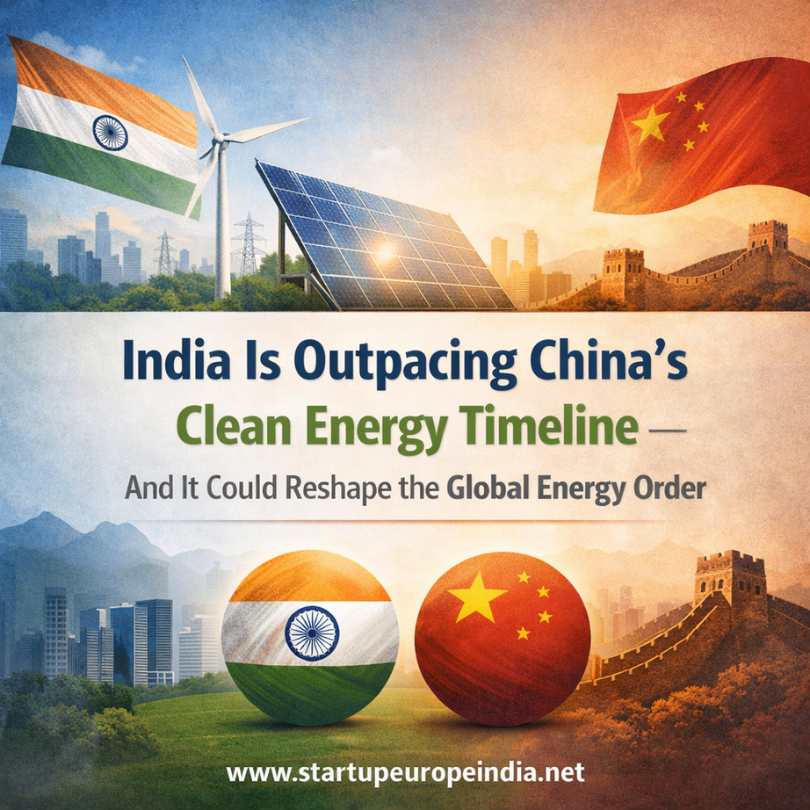
India Is Outpacing China’s Clean Energy Timeline - And It Could Reshape the Global Energy Order
India
Sarah   J

Sarah J

Posted on Wed, Feb 11, 2026

10 min read

Share the article with your network

x
Facebook
linkedin

A new Ember report reveals India is electrifying faster and burning far less fossil fuel per capita than China did at the same stage of economic development. The implications extend well beyond South Asia.

Published: February 11, 2026

When Prem Chand, a rickshaw driver in Delhi, switched from a gas-powered vehicle to an electric three-wheeler eight months ago, he did it for one reason: economics. The e-rickshaw costs less to run and, as a bonus, produces zero tailpipe emissions in a city routinely ranked among the world’s most polluted. His story, reported by CNN on February 11, 2026, is a microcosm of a much larger transformation sweeping the world’s most populous nation.

India is now electrifying its economy faster than China did at an equivalent stage of development, burning significantly less coal per capita in the process. That is the central finding of a January 2026 report from Ember, a London-based energy think tank, titled “India’s Electrotech Fast-Track: Where China Built on Coal, India Is Building on Sun.” The analysis, which adjusts GDP per capita for purchasing power parity using World Bank data, compares India today (roughly $11,000 per person) with China in 2012, when both countries sat at similar income levels.

The implications reach far beyond the subcontinent. India is the world’s third-largest greenhouse gas emitter. If it can industrialise without replicating China’s coal-intensive pathway, it offers a proof of concept that other emerging economies in Africa, Southeast Asia, and Latin America could follow.

The Data: India vs. China at Equivalent Development Levels

The Ember report uses electricity data from its own global dataset, final energy data from the International Energy Agency (IEA) World Energy Balances, and GDP figures from the World Bank to draw its comparisons. The results are striking across three key metrics: coal dependency, solar capacity, and electric vehicle adoption.

Key Comparative Metrics: India Today vs. China in 2012

Solar share of electricity India (2025): ~9% | China (2012): Negligible

Per capita coal generation India (2025): ~1 MWh | China (2012): ~2.5 MWh (40% higher ratio)

EV share of car sales India (2025): ~5% | China (2012): Near zero

Electric three-wheeler leadership India (2025): Global No. 1 | China (2012): N/A

Electrification rate (final energy) India (2025): ~20% | China (2012): ~20% (similar threshold)

Per capita road oil demand India (2025): 96 litres (gasoline equiv.) | China (2012): ~192 litres

Solar-plus-storage vs. new coal cost India (2025): Solar ~50% cheaper | China (2012): Coal ~10x cheaper than solar

Sources: Ember (Jan 2026), IEA World Energy Balances, World Bank PPP data, IRENA RE Statistics 2025, BloombergNEF.

The coal comparison is particularly significant. India’s per capita coal generation stands at roughly 1 MWh, about 40% of what China was burning at the same income level. According to Ember, Indian coal-fired generation fell year-on-year in 2025 for the first time, although analysts attribute part of that decline to unusually mild weather reducing cooling demand. The Ember and TERI least-cost pathway projects plateauing coal demand through to 2030, and the IEA’s Stated Policies scenario sees India’s coal demand in 2035 at approximately today’s level.

On the oil side, India’s per capita road oil demand is about 96 litres of gasoline equivalent, roughly half of China’s in 2012. According to Ember, India’s road oil demand is approaching its peak. As the report noted, India is unlikely to rescue the oil industry.

The Economics Driving the Shift: Why Cost Trumps Ideology

India’s clean energy transition is not principally a climate story. It is an economics story. As Kingsmill Bond, energy strategist at Ember and a co-author of the report, explained to CNN, when China crossed approximately 1,500 kWh of electricity use per capita around 2004, coal generation was about ten times cheaper than nascent solar photovoltaics. Coal consequently supplied roughly 70% of the growth in China’s electricity generation over the subsequent decade.

India is now crossing the same 1,500 kWh threshold in a fundamentally different cost environment. Solar-plus-battery-storage is about half as expensive as new coal plants. Battery prices alone dropped 40% in 2024, according to Bond. These cost reductions follow a consistent technology learning curve: solar, wind, and battery costs decline by roughly 20% every time deployment doubles. Fossil fuels, by contrast, tend to become more expensive as accessible reserves are depleted and producers control supply.

This cost advantage is already visible in India’s renewable deployment numbers. In the first eleven months of 2025, India added approximately 35 GW of solar capacity, 6 GW of wind, and 3.5 GW of hydropower, a 44% increase in renewable additions compared to the previous year. India’s solar installed capacity reached 132.85 GW by November 2025, a 41% jump from 94.17 GW a year earlier, according to India’s Ministry of New and Renewable Energy. Wind energy capacity crossed the 50 GW mark in March 2025. BloombergNEF projects India will add over 50 GW of new solar capacity in 2026, potentially surpassing the United States to become the world’s second-largest solar market after China.

India has already overtaken Japan to become the world’s third-largest solar energy producer, generating 108,494 GWh of solar power compared to Japan’s 96,459 GWh, according to IRENA’s 2025 Renewable Energy Statistics. As of mid-2025, renewables accounted for over 50% of India’s total installed power capacity, hitting a target set under its Paris Agreement commitments five years ahead of the 2030 deadline.

Energy Sovereignty in an Unstable World

India imports close to 90% of its oil and approximately half its natural gas, according to IEA data. That dependency exposes the country to price shocks and geopolitical instability. As Thijs Van de Graaf, an associate professor of international politics at Ghent University, told CNN, renewables help reduce this vulnerability.

The concept of energy independence carries different meanings in different capitals. In Washington, the Trump administration uses the phrase as shorthand for expanding oil, gas, and coal production while curtailing wind and solar development. For New Delhi, energy independence increasingly means building domestic clean energy manufacturing capacity to reduce reliance on both fossil fuel imports and Chinese supply chains.

India’s solar module manufacturing capacity nearly doubled in a single year, from 38 GW in March 2024 to 74 GW in March 2025. PV cell manufacturing capacity jumped from 9 GW to 25 GW over the same period. India launched its first 2 GW ingot-wafer plant, a step toward a more complete domestic solar supply chain. The government has also launched a National Critical Mineral Mission to reduce dependence on Chinese mineral inputs, and introduced customs duties on imported solar equipment to incentivise domestic production.

This industrial strategy intersects with broader geopolitical realignments. A major trade deal signed between India and the European Union in January 2026 has been interpreted as a signal that both parties are seeking to diversify trade relationships away from overreliance on either the United States or China. As Ember’s report noted, the US is becoming an increasingly unreliable trade partner, and China’s supply-chain dominance is generating anxiety worldwide, creating growing demand for alternative partners.


The ‘Electrostate’ Thesis: A New Framework for Global Energy

Ember’s broader research programme introduces the concept of “electrostates”: nations that meet most of their energy needs through electricity generated from clean sources. No country has fully achieved this status yet, but Bond and his colleagues argue that the direction of travel is unmistakable.

The argument rests on three converging trends. First, renewable supply from solar and wind is scaling exponentially. Second, demand-side electrification, through electric vehicles, heat pumps, and industrial processes, is accelerating. Third, batteries and digital grid management are solving the intermittency problem. Together, these three technology groups form what Ember calls “electrotech.”

The global numbers support the thesis. Solar and wind supplied 17.6% of global electricity in the first three quarters of 2025, up from 15.2% over the same period in 2024, according to Ember’s Q3 Global Power Report. For the first time across a sustained period, renewables generated more electricity than coal globally. Ember forecasts that 2025 will be the first year without notable fossil fuel growth in global electricity generation since the COVID-19 pandemic.

Electrotech contributed an estimated 10% of global GDP growth in 2023, including 22% in China, 5% in India, 30% in the EU, and 7% in the US. The sector now captures two-thirds of global energy investment and is responsible for all expected growth in energy jobs. Around 80% of the world’s population lives in fossil fuel-importing countries, and 92% of countries have renewables potential exceeding ten times their current demand. Replacing imported fossil fuels using EVs, heat pumps, and renewables could cut net fossil fuel imports by 70%, saving an estimated $1.3 trillion globally per year, according to Ember’s September 2025 Electrotech Revolution report.

The Challenges India Still Faces

The optimistic trajectory comes with significant caveats. India’s soaring energy demand means that even though renewables are being added at pace, coal is not yet being displaced from the grid, according to Debajit Palit from the Centre for Climate Change & Energy Transition at the Chintan Research Foundation. India has plans to continue scaling coal capacity over the next two decades, and its oil consumption continues to grow, according to IEA country data.

Supply chain dependency remains a serious vulnerability. India’s clean energy rollout still relies heavily on Chinese-made equipment and Chinese-controlled critical mineral supply chains. In early 2026, Reliance Industries reportedly put its plans to manufacture lithium-ion battery cells domestically on hold after failing to secure the necessary production equipment from China. Bond acknowledged that these risks could grow as trade becomes more contentious.

Grid infrastructure is another bottleneck. Integrating large volumes of intermittent solar and wind power requires modernised transmission networks, battery storage at scale, and market reforms to enable flexible, renewable-heavy systems. India’s Ember-TERI least-cost pathway analysis suggests the country does not need to build coal capacity beyond what is already planned under its National Electricity Plan 2032, provided it meets its targets for solar, wind, and storage.

India’s e-rickshaw revolution also illustrates the messy reality of rapid electrification. Many e-rickshaws operate without authorisation and run on stolen electricity. The transition is unfolding faster than regulatory frameworks can adapt, a pattern likely to intensify as electrification spreads to other sectors.

What This Means for Emerging Economies

India’s pathway is not unique. Countries across the developing world are beginning to take advantage of the same cost dynamics. Ember’s research shows that 63% of emerging market electricity demand has leapfrogged the United States in terms of solar as a share of generation. The ASEAN region and Bangladesh have surpassed the US in terms of electrification of final energy demand. Solar is accelerating across Africa, with countries like South Africa and Pakistan already using low-cost Chinese solar panels to bypass fossil-fuel-intensive development paths.

The key insight from Ember’s analysis is that India’s development at this particular moment in history, when electrotech costs have plummeted, allows it to follow a fundamentally different energy trajectory than the one available to China or Western economies during their industrialisation. Nations that are less developed than India today will see even greater advantages as clean energy costs continue falling.

As Van de Graaf told CNN, there is a growing divergence: a US prioritising fossil fuel dominance, and emerging economies positioning themselves for an electrified energy future. The irony, several analysts have noted, is that President Trump’s transactional, go-it-alone approach to energy policy may be accelerating this shift by pushing energy-import-dependent countries to reduce their exposure to volatile fossil fuel markets and unreliable trade partnerships.

India is not yet a clean energy superpower. It remains heavily dependent on coal, its grid infrastructure needs substantial upgrades, and its supply chains are uncomfortably tied to China. But the trajectory documented by Ember’s research, and corroborated by IEA data, IRENA statistics, and BloombergNEF projections, is unmistakable: India is generating more solar power, burning far less fossil fuel per capita, and electrifying transportation at a faster rate than China did at the same level of economic development.

The difference is not ideological. It is economic. When solar-plus-storage costs half as much as new coal, and battery prices are falling 40% in a single year, the rational choice for an energy-import-dependent nation of 1.4 billion people is not difficult to identify. What remains uncertain is not whether India will continue electrifying, but whether it can do so fast enough to meet its exploding energy demand without locking in another generation of fossil fuel infrastructure.

For the rest of the emerging world, India’s experience is the most relevant case study available. If the world’s most populous country can industrialise on cheap solar instead of coal, the orthodox assumption that developing nations must follow the fossil fuel pathway is effectively over.

---

Join SEINET — the digital partnership infrastructure for tech businesses and leaders in EU-UK and India corridor. Start with a verified community, and unlock access to the exclusive Leaders Network for qualified founders and decision-makers. Build trusted partnerships and collaborate efficiently across markets www.startupeuropeindia.net

---

Sources and References

• Ember, “India’s Electrotech Fast-Track: Where China Built on Coal, India Is Building on Sun,” January 22, 2026.

• Ember, “The Electrotech Revolution,” September 2025.

• Ember, “Q3 Global Power Report: No Fossil Fuel Growth Expected in 2025,” November 2025.

• CNN, Laura Paddison, “China Is the Clean Energy Superpower, But There’s Another Snapping at Its Heels,” February 11, 2026.

• International Renewable Energy Agency (IRENA), Renewable Energy Statistics 2025 and Renewable Capacity Statistics 2025.

• International Energy Agency (IEA), India Country Profile: Oil, Natural Gas, and Energy Balances.

• Government of India, Ministry of New and Renewable Energy, Press Release, December 2025.

• BloombergNEF, India Solar Capacity Projections 2026 (via The Economic Times).

• Centre for Research on Energy and Clean Air, Analysis on Peak Power Sector Emissions, 2025.

• India Brand Equity Foundation (IBEF), Renewable Energy Industry Report, 2025.

You may also like

Sarah   J

Sarah J

Thu, Feb 19, 2026

OpenAI for India: Infrastructure, Enterprise Adoption, and Workforce Scale

On 18 February 2026, at the India AI Impact Summit in Delhi, OpenAI announced OpenAI for India, a long-term programme built around local infrastructure, enterprise deployment, and workforce development. The initiative positions India not only as a large user base for AI tools, but as a strategic geography for infrastructure and institutional partnerships.The announcement makes four commitments clear: build local AI-ready capacity, deepen enterprise integration, expand certifications and academic access, and grow on-the-ground operations in India.Scale of usageOpenAI stated that India now has more than 100 million weekly ChatGPT users. That scale alone explains why the company is formalising a structured programme rather than continuing with isolated commercial partnerships. India is already one of the largest markets for AI usage globally; the announcement recognises that reality and moves toward institutional integration.Infrastructure: Data residency and capacityA central element of the programme is a partnership with the Tata Group, specifically through Tata Consultancy Services (TCS).OpenAI will become the first customer of TCS’s HyperVault data-centre business. The arrangement begins with 100 megawatts of AI-ready capacity, with the potential to scale to 1 gigawatt over time. The stated objectives are data residency, security, and reduced latency for mission-critical and government workloads.This is operationally significant. On-shore data capacity addresses regulatory and enterprise concerns around cross-border data flows. Reduced latency matters for real-time AI applications. Dedicated AI-ready infrastructure signals that the company is not treating India as a peripheral deployment region, but as a primary infrastructure geography.The reference to the global Stargate effort indicates that India is being folded into OpenAI’s broader data-centre expansion strategy rather than handled as a standalone market experiment.Enterprise rollout: From pilot to institutional useThe programme also includes a strategic enterprise collaboration with the Tata ecosystem. OpenAI plans to deploy ChatGPT Enterprise across Tata employees, beginning with hundreds of thousands of TCS employees. The announcement also references the use of OpenAI’s Codex to support AI-native software development workflows.For a services firm of TCS’s size, this represents a potential shift from experimental AI usage to standardised deployment. The scale of the employee base makes this one of the largest structured enterprise rollouts announced publicly.The practical impact will depend on implementation details that have not yet been disclosed: governance frameworks, access controls, internal policy integration, measurement of productivity outcomes, and alignment with client confidentiality requirements. But the signal is clear — AI tools are being positioned as core enterprise infrastructure rather than optional add-ons.Workforce and education: Certifications and accessThe announcement extends beyond enterprise. OpenAI will expand its certification programmes in India, with TCS becoming the first participating organisation outside the United States for OpenAI Certifications.In addition, OpenAI is providing 100,000 ChatGPT Edu licences to selected institutions, including:Indian Institute of Management AhmedabadAll India Institute of Medical Sciences, New DelhiManipal Academy of Higher EducationUniversity of Petroleum and Energy StudiesPearl AcademyThe institutions listed span management, medicine, engineering, and design. That breadth suggests a cross-disciplinary approach rather than limiting AI access to technical departments. The long-term question will be how these licences translate into curriculum integration, assessment standards, and employability outcomes.Local presence: Expanding operationsOpenAI also plans to open offices in Mumbai and Bengaluru later in 2026, adding to its existing New Delhi presence. This reflects an intent to embed locally — in policy dialogue, enterprise partnerships, and developer ecosystems — rather than operate remotely.Mumbai anchors finance and corporate headquarters. Bengaluru anchors technology and engineering talent. The geographic selection aligns with enterprise and developer priorities.What this means in practical termsThree structural implications emerge from the announcement:First, infrastructure localisation is becoming non-negotiable. Data residency and sovereign compute capacity are increasingly prerequisites for large-scale AI adoption in regulated sectors. By committing to AI-ready capacity inside India, OpenAI is aligning with this requirement.Second, enterprise adoption is moving from experimentation to standardisation. Deploying enterprise-grade AI tools across hundreds of thousands of employees signals institutionalisation. Whether productivity gains materialise will depend on execution, training, and governance.Third, workforce capability is being treated as infrastructure. Certifications and university licences are not marketing gestures; they are part of ecosystem building. AI adoption at national scale requires trained users, not just APIs and data centres.The announcement does not disclose commercial terms, pricing structures, data governance contracts, or deployment timelines. It does not specify how capacity will be phased or when the full 100 megawatts will be operational. These are reasonable areas for follow-up scrutiny.However, the commitments that are public — infrastructure capacity, named institutional partnerships, enterprise deployment plans, and office expansion — are concrete and verifiable. The programme is framed as long-term rather than promotional.India’s scale of AI usage, combined with its services-led technology economy, makes it a consequential market for AI providers. OpenAI for India reflects recognition of that fact. The programme now moves from announcement to execution — and its impact will ultimately be measured not by statements at a summit, but by how effectively infrastructure, enterprises, and institutions translate access into measurable outcomes.---Join the Startup Europe India Network — the network connecting Europe and India’s tech and science ecosystems to drive partnerships and scale innovation.www.startupeuropeindia.net
Thu, Feb 19, 2026
OpenAI for India: Infrastructure, Enterprise Adoption, and Workforce Scale
Sarah   J

Sarah J

Thu, Feb 19, 2026

Google Announces America-India Connect Initiative with New Fiber-Optic Routes to Boost AI Connectivity

Tech giant Google has unveiled a major infrastructure initiative called America-India Connect as part of its strategic expansion in India. The project announced at the India AI Impact Summit 2026 in New Delhi will establish new subsea fiber-optic routes and enhanced digital connectivity between the United States and India, along with strategic links to other regions of the Southern Hemisphere. This move highlights India’s growing importance as a launchpad for next-generation artificial intelligence, cloud computing and digital services. The “America-India Connect” initiative builds on Google’s previously announced US$15 billion investment plan in India over the next five years, which includes the construction of a gigawatt-scale AI data centre hub in Visakhapatnam and expanded subsea connectivity designed to support AI training, hyperscale cloud workloads and high-capacity data traffic. The new subsea cable network will include three undersea paths linking India with Singapore, South Africa and Australia, along with multiple terrestrial fiber routes connecting India with the U.S. and other global nodes. Alphabet CEO Sundar Pichai, speaking at the summit, described the connectivity strategy as part of Google’s long-term commitment to expanding digital infrastructure that underpins artificial intelligence adoption across sectors such as healthcare, education, agriculture and enterprise services. He noted that enhanced fiber-optic and subsea networks are essential to supporting low-latency, high-capacity data flows required by advanced AI applications and cloud computing. In addition to subsea and fiber infrastructure, Google is expanding regional partnerships with institutions and governments to accelerate AI research and public services. The company has earmarked funding and collaborative programs aimed at training talent, delivering responsible AI tools and fostering access to frontier models for scientific and enterprise applications. The new infrastructure anchored by a subsea gateway in Visakhapatnam is expected to deepen India’s role in global digital trade corridors, diversifying connectivity beyond traditional landing points such as Mumbai and Chennai. This diversification enhances network resilience and creates broader routes for global data movements between continents, strengthening access to AI-driven services and digital platforms across emerging and established markets. Google’s investment reflects broader global trends where digital infrastructure particularly fiber-optic and submarine cable networks increasingly shapes economic competitiveness, innovation ecosystems and cross-border data flows in an era defined by cloud computing, digital services and artificial intelligence. Google’s America-India Connect initiative signals a fundamental shift in how digital infrastructure is being positioned as a strategic platform for innovation, collaboration and economic integration across continents. Enhanced subsea fiber connectivity between India and the U.S. not only supports faster AI workloads and cloud computing deployments but also lays the groundwork for cross-regional collaboration between European, Indian and global tech ecosystems.This improved digital backbone strengthens opportunities for startup partnerships in AI, cloud services, cybersecurity, data analytics and digital infrastructure, enabling European and Indian ventures to jointly develop, scale and deploy solutions that require high-performance global connectivity. --Join SEINET - the digital partnership infrastructure for tech businesses and leaders in EU-UK and India.Start with a verified community, and unlock access to the exclusive Leaders Network for qualified founders and decision-makers. Build trusted partnerships and collaborate efficiently across markets www.startupeuropeindia.net
Thu, Feb 19, 2026
Google Announces America-India Connect Initiative with New Fiber-Optic Routes to Boost AI Connectivity
Sarah   J

Sarah J

Sat, Feb 14, 2026

The State of AI in India: Models, Deployment, Semiconductors, and Regulation

India's artificial intelligence trajectory differs fundamentally from both US and Chinese approaches. While the US prioritizes frontier model development through hyperscaler-led research and China pursues state-directed AI advancement, India's strategy centers on population-scale deployment infrastructure, multilingual adaptation, and progressive sovereignty building. This analysis examines India's current AI status across the full technology stack - from semiconductors and compute to foundation models, regulation, and real-world systems.Strategic Context: Infrastructure-First AIIndia operates from a position of structural advantage in one domain and dependence in another. The advantage: digital public infrastructure (DPI) reaching over a billion citizens through systems like Aadhaar (biometric identity), UPI (real-time payments processing 12.1 billion transactions monthly as of December 2024), and India Stack's interoperable data architecture. The dependence: foreign foundation models, advanced semiconductors, and hyperscale compute capacity.This asymmetry shapes India's AI strategy: deploy rapidly on existing infrastructure while simultaneously building upstream capabilities in models, chips, and sovereign compute. The approach is sequential rather than simultaneous - accepting short-term dependencies to accelerate near-term impact while investing in long-term independence.Foundation Model Development: Public and Private InitiativesBharatGen: Government-Funded Multimodal AILaunched September 30, 2024, BharatGen represents India's first government-funded sovereign foundation model initiative. Led by IIT Bombay under the Department of Science and Technology's National Mission on Interdisciplinary Cyber-Physical Systems (NM-ICPS), with consortium partners including IIT Madras, IIT Kanpur, IIT Hyderabad, IIT Mandi, IIIT Hyderabad, IIT Kharagpur, IIIT Delhi, and IIM Indore.Budget allocation: ₹235 crore through Technology Innovation Hub at IIT Bombay, expanded to ₹1,058 crore under IndiaAI Mission (November 2024).Technical scope:Text models across 22 Indian languages (covering all Scheduled languages)Automatic Speech Recognition (ASR) and Text-to-Speech (TTS) with 15,000+ hours annotated voice dataDocument vision capabilities for Indian formats (handwritten forms, government documents, certificates)Training on "Bharat Data Sagar"-indigenous data repository capturing regional diversityCurrent status (as of February 2026):Models operational for text and speech across 22 languagesProof-of-concept applications deployed in governance and citizen servicesOpen-source release planned for text and TTS models in 2025-2026Government and trusted partners receive selective access to advanced capabilitiesBharatGen supports conversational AI, machine translation, speech recognition, document digitization for Indian-specific formats (tables, manuscripts, administrative documents). The initiative focuses on governance, education, healthcare, and agriculture rather than frontier research competition.Limitations: While representing significant progress, BharatGen models remain below frontier capabilities of GPT-4, Claude 3.5, or Gemini 1.5. The 2-billion parameter base models handle Indic language tasks effectively but lack the reasoning depth and multimodal sophistication of 100B+ parameter frontier systems.Sarvam AI: Commercial Sovereign AI PlatformFounded 2023 by Vivek Raghavan and Pratyush Kumar, Sarvam AI has emerged as India's leading private-sector AI company. In April 2025, the government selected Sarvam as the first startup under IndiaAI Mission to develop India's sovereign Large Language Model with dedicated compute access.Funding: $41 million Series A (December 2023) from Lightspeed, Peak XV Partners, Khosla Ventures-among largest early-stage AI funding rounds in India.Model portfolio:Sarvam-1 (October 2024):7-billion parametersTrained on 1.2 TB Indian data (government portals, literature, community contributions)Supports 10 Indian languages with code-mixed inputs (Hinglish, Tanglish)Open-source under permissive licensesSarvam-2B:2-billion parametersEdge-optimized (<500 MB compressed for mobile deployment)Energy-efficient for 2G networksTrained on 4 trillion tokensSarvam Vision (January 2025):3-billion parameter vision-language modelDocument understanding: charts, tables, manuscripts, financial documentsKnowledge extraction beyond OCR (understands structure, context)Benchmarks: outperforms GPT-4o and Gemini on India-specific document tasksBulbul V3 (TTS):35+ professional voices across 11 Indian languages (expanding to all 22)Handles code-switching, regional variations, prosodyNatural speech with Indian accents and linguistic nuancesSaaras V3 (ASR):23 languages (22 Indian + English)Multiple output modes: transcribe, translate, verbatim, transliteration, code-mixBenchmarks: lower word error rates than Gemini and GPT-4o on IndicVoices and SvarahSarvam-Translate:Built on Gemma 3-4BTranslates across all 22 official Indian languagesHandles Markdown, HTML, LaTeX, code, scientific notation100,000+ translation requests weeklyPowers 10 million+ conversation turns via Samvaad platformSovereign LLM project (April 2025): Under IndiaAI Mission, Sarvam is building three model variants with 4,000 GPU access for 6 months:Sarvam-Large: Advanced reasoning and generationSarvam-Small: Real-time interactive applicationsSarvam-Edge: On-device compact tasksTarget: 70-billion+ parameters trained on sovereign Indian infrastructureDeployment: Domestic data centers, developed by Indian talentCollaboration with AI4Bharat at IIT MadrasEnterprise deployment: Sarvam powers AI for Unique Identification Authority of India (UIDAI), Ministry of Skill Development and Entrepreneurship, NITI Aayog, Urban Company, Neowise, and financial services firms. Use cases include multilingual customer service, government workflow automation, document intelligence.Performance reality: Sarvam models excel on India-specific benchmarks (Indic languages, document types, cultural context) but trail frontier models on general reasoning, complex multi-step tasks, and English-language performance. The gap narrows significantly for vernacular applications-Sarvam's core market.Krutrim (Ola AI): Vertically Integrated AI StackFounded by Bhavish Aggarwal (Ola founder), Krutrim became India's first AI unicorn in 2024 ($50 million at $1 billion valuation). Aggarwal committed $230 million from his family office in early 2025, with plans to raise $1.15 billion by 2026.Model development:Krutrim-1 (2024):7-billion parametersBuilt on Llama-2 architectureTraining: October-November 2023 on 2+ trillion tokensData cutoff: April 2023Supports Indian languages, but criticism for basic reasoning failuresKrutrim-2 (February 2025):12-billion parametersBuilt on Mistral-NeMo 12B architecture128K token context windowTraining: December 2024 - January 2025Data includes web, code, math, Indic languages, Indian context, synthetic dataOpen-sourced with mixed community receptionChitrarth (VLM):Vision-language model trained on multilingual image-text data10 Indian languages + EnglishDesigned for cultural context and accurate Indic representationDhwani (Speech LLM):End-to-end trained speech model based on Krutrim-1Speech-to-text translation between 8 Indic languages and EnglishOpen-sourced translation capabilitiesVikhyarth:Sentence transformer for semantic similarity, search, clustering100+ languages with focus on 10 Indian languagesKrutrim-Translate:Supports 9 Indian languages + EnglishKruti AI Assistant (June 2025): Krutrim's consumer-facing product-an "agentic" AI that plans, reasons, and executes multi-step tasks:Voice and text in 13 Indian languages (expanding to 22)Integrations: Ola cabs, Ola Maps, food delivery, bill payments, UPIModes: Auto (quick answers), In-depth (research), Agents (task execution)Powers real-time booking, payments, information retrievalFuture: offline capabilities plannedInfrastructure:Krutrim Cloud: Sovereign GPU infrastructure with A100 instances, competitive INR pricingPartnership with Cloudera for data platform (large-scale analytics, data lakes)Partnership with Nvidia for Blackwell GB200 GPUsVertically integrated: compute, storage, data management, AI applicationsBharatBench: Proprietary benchmark designed to capture Indian language nuances and cultural contexts, addressing gaps in English/Chinese-dominated evaluation frameworks.Enterprise reality: Krutrim's strategy is infrastructure-first rather than model-first. The cloud platform and agentic capabilities matter more than foundational model quality. However, the company faces challenges:100+ linguistics staff layoffs in 2025 (shift from annotation to agentic focus)Senior engineering exits raising culture questionsWorkplace stress reports including a tragic engineer suicideModel performance criticized for basic logic failures despite language capabilitiesAcquisition (June 2025): BharatSah'AI'yak-AI platform for government, education, healthcare-expanding Kruti's reach into public sector applications.Model Assessment: Where India StandsStrengths:Indic language proficiency (surpasses global models on vernacular benchmarks)Document intelligence for Indian formats (government IDs, handwritten forms, complex tables)Speech recognition for regional accents and code-mixed languageCultural context understanding (idioms, references, code-switching)Edge optimization (low-bandwidth, mobile-first deployment)Cost efficiency for Indian market conditionsWeaknesses:Reasoning capabilities lag GPT-4, Claude 3.5, Gemini 1.5 by significant marginsParameter counts (2B-12B) insufficient for complex multi-step tasksTraining compute limited compared to frontier labs (thousands vs tens of thousands of GPUs)English-language performance below global standardsMultimodal sophistication years behind OpenAI, Anthropic, Google, MetaScientific, mathematical, coding capabilities nascentStrategic positioning: Indian models are not competing for frontier leadership. They target deployment sovereignty in vernacular markets-an economically viable and strategically important niche. The question is whether this approach builds sufficient capability for eventual frontier participation or permanently relegates India to downstream adaptation.IndiaAI Mission: $1.2 Billion National AI ProgramApproved March 2024, budget ₹10,371.92 crore ($1.24 billion) over five years under vision "Making AI in India and Making AI Work for India."Seven Pillars:1. IndiaAI Compute CapacityInitial target: 10,000 GPUs via public-private partnershipsCurrent capacity (February 2026): 38,000 GPUs (18,693 deployed, 16,000+ added in Phase 2)Infrastructure: H100, H200 units at subsidized ratesPricing: <₹100/hour (~$1.20) vs $2.50 globally-60% cost reductionAccess: Startups, academia, MSMEs, research community, government agenciesProviders: Yotta Data Services, other empaneled cloud partners2. IndiaAI Innovation CentreCentres of Excellence in healthcare, agriculture, sustainable cities, educationIndustry-academia-government collaboration for scalable solutionsCompute subsidies: 40% government support3. IndiaAI Datasets Platform (AIKosha)Launched March 2025367 datasets uploaded (as of June 2025)High-quality Indian datasets for startups and researchersFocus on Indic languages, cultural contexts, regional diversity4. IndiaAI Foundation Models500+ proposals receivedPhase 1 (selected): Sarvam AI, Soket AI, Gnani AI, Gan AIPhase 2 expansion: Avaatar AI, IIT Bombay (BharatGen), Zenteiq, Gen Loop, Intellihealth, Shodh AI, Fractal Analytics, Tech Mahindra Maker's LabTotal: 12 startups selected to build indigenous multimodal modelsFocus: India-specific data, sovereign deployment, cultural relevance5. IndiaAI FutureSkills13,500 scholars supported: 8,000 undergraduates, 5,000 postgraduates, 500 PhD fellows73 institutes onboarding PhD students (200+ students by July 2025)AI and Data Labs: 31 operational (target 570-lab network)Partnership: NIELIT, industry partnersLocations: Tier 2 and Tier 3 cities for inclusive access174 ITIs and polytechnics nominated by states/UTs6. IndiaAI Startup FinancingIndiaAI Startups Global Acceleration Programme (March 2025)10 startups selected for European market expansionPartnership: Station F (Paris) and HEC ParisStreamlined access to funding for product development to commercialization7. Safe & Trusted AI13 projects selected focusing on:Machine unlearningBias mitigationPrivacy-preserving MLExplainabilityAuditing frameworksGovernance testingIndiaAI Safety Institute: Expression of Interest published May 2025 for partner institutionsEmphasis on responsible AI deployment with governance frameworksProgress metrics:89% of startups launched in 2024 integrated AINASSCOM AI Adoption Index: 2.45/4.0 (rapid enterprise integration)Stanford AI Index: India ranks top 4 globally in AI skills, capabilities, policiesGitHub: India is 2nd-largest contributor to AI projectsTechnology sector revenue: projected $280 billion in 2025AI economic impact estimate: $1.7 trillion by 2035Regulatory Framework: Data Protection and AI GovernanceDigital Personal Data Protection Act (DPDPA), 2023Status: Enacted August 11, 2023; Rules notified November 13, 2025; Effective date: May 13, 2027 (18-month implementation window for all entities).Scope:Applies to digital personal data processed within IndiaApplies to data processed outside India if connected to offering goods/services to Indian data principalsDoes NOT apply to outsourcing services processing foreign-collected data for non-Indian principalsKey provisions affecting AI:1. Publicly Available Data Exemption (Section 3(c)(ii)):DPDPA does NOT apply to data made publicly available by data principals or persons legally required to publishThis is broader than GDPR, Singapore PDPA, Canada PIPEDAImplication: AI models can freely process publicly available personal data without consent requirementsCriticism: Insufficient safeguards for scraped web data used in training2. Automated Processing:Section 2(b) defines "Automated" as digital processes without human input once initiatedImplies AI systems performing decision-making or predictions are subject to DPDPA rulesHowever, Act does NOT explicitly address:Algorithmic biasTransparency requirementsExplainability of AI decisionsAutomated decision-making rights (unlike GDPR Article 22)3. Data Fiduciary Obligations:Consent requirement for processing personal dataPurpose limitation and data minimizationStorage limitationSecurity safeguardsSignificant Data Fiduciaries (large AI firms) must:Appoint Data Protection Officer (DPO)Conduct Data Protection Impact Assessments (DPIAs)Undergo regular auditsReport breaches to Data Protection Board within 72 hours4. Data Principal Rights:Access, correction, erasure, grievance redressalRight to nominate consent manager (third-party infrastructure for managing consents)Prohibition on processing detrimental to children (tracking, behavioral monitoring, targeted advertising)5. Penalties:Range: ₹10,000 ($120) to ₹250 crore ($30.2 million)Determined by Data Protection Board of India based on offense severityGaps for AI:No specific AI regulation (unlike EU AI Act)No risk-based classification of AI systemsNo requirements for algorithmic transparency or fairness auditsNo provisions for synthetic data, deepfakes, AI-generated contentConsent framework may not address complex AI training pipelinesProposed Digital India Act (DIA)Status: Under development; expected to complement DPDPA with AI-specific provisions.Anticipated elements:Risk-based classification of AI systems (unacceptable, high-risk, minimal risk)Enhanced duties for digital intermediariesRegulation of synthetic and AI-generated mediaMandatory labeling of AI-generated content (proposed amendment to IT Rules 2021)Regulatory sandboxes to foster innovationPlatform accountability measuresTransparency and accountability frameworksComparison context: Unlike EU AI Act (comprehensive AI regulation with strict high-risk obligations), India appears to favor enabling innovation while establishing guardrails post-facto. The approach prioritizes deployment velocity over precautionary governance.Information Technology Act, 2000Relevance to AI:Section 43A: Compensation for data protection failures (does NOT address AI-specific risks)Section 66: Cybercrimes (overlooks AI-driven misinformation, algorithmic manipulation)Section 66A: Struck down 2015 as unconstitutional (creates gap for harmful AI content, deepfakes)Section 69: Surveillance powers (lacks safeguards against AI-based facial recognition, intrusive tech)Verdict: IT Act inadequate for modern AI challenges; requires significant amendments or replacement via Digital India Act.Existing AI Governance ApproachMeitY advisories:Intermediary platforms must ensure reliable AI output generationCitizens must be informed of AI system limitations and risksNo legally binding AI-specific framework yetNational Commission for Women:"Review of Cyber Laws Relating to Women" (comprehensive gender lens analysis)Highlights gaps in addressing AI-driven harms to womenPhilosophy: India has adopted a harnessing-first, regulating-later approach. The emphasis is on capturing AI's economic potential while developing governance frameworks incrementally. This contrasts with EU's precautionary principle but aligns with US innovation-first stance-albeit without US-level private sector maturity.Semiconductor Strategy: Building Compute SovereigntyIndia Semiconductor Mission (ISM)Established: 2021 under Ministry of Electronics and IT (MeitY) as nodal agency for semiconductor ecosystem development.Objective: Domestic semiconductor capability across fabrication, design, assembly/packaging, supply chains.Incentive structure:Up to 50% fiscal support for semiconductor fabs (pari-passu basis)50% capital expenditure support for compound semiconductors, silicon photonics, sensors (MEMS), discrete semiconductors50% support for ATMP/OSAT (assembly, testing, marking, packaging) facilitiesDesign Linked Incentive (DLI) Scheme: 5-year financial incentives for IC/chipset/SoC/IP core designISM 2.0 (announced): Focus areas: Equipment & Materials, Design IP, Supply Chains, R&D Centres (building on ISM 1.0's fabrication achievements).Approved Projects (10 total as of February 2026)1. Tata Electronics - Semiconductor Fab (Dholera, Gujarat)Investment: ₹91,526 crore (~$11 billion)Technology partner: Powerchip Semiconductor Manufacturing Corporation (PSMC), TaiwanFiscal Support Agreement signed: March 5, 2025Capacity: 50,000 wafers per month (300mm/12-inch fab)Technology nodes: 28nm, 40nm, 55nm, 90nm, 110nmApplications: Power management ICs, display drivers, MCUs, high-performance computing logicMarket segments: AI, automotive, computing, data storage, wireless communicationEmployment: 20,000+ direct/indirect skilled jobsTimeline: Construction began 2024, production expected late 2026Significance: India's first commercial AI-enabled semiconductor fabStatus: Definitive agreement with PSMC completed September 26, 2024; FSA signed March 2025; construction underway with "great urgency"2. Tata Semiconductor Assembly and Test (TSAT) - OSAT Facility (Jagiroad, Assam)Investment: ₹27,000 croreCabinet approval: February 29, 2024Groundbreaking ceremony: August 3, 2024Technologies: Wire Bond, Flip Chip, Integrated Systems Packaging (ISP)Employment: 27,000+ direct/indirect jobsTimeline: Construction 2024, Phase 1 operational mid-2025Significance: India's first indigenous greenfield semiconductor assembly and test facilityImpact: Major industrialization milestone for North-East IndiaReported partnership: Strategic deal with Tesla (April 2024) to supply chips for global operations-India joining Taiwan, China, South Korea as chip supplier3. Micron Technology - ATMP Facility (Gujarat)Investment: $2.75 billion+Approval: 2023Product focus: DRAM and NAND assembly and testSignificance: First major US semiconductor investment in India4. CG Power & Industrial Solutions - Semiconductor Manufacturing UnitLocation: Details under FSA with ISMStatus: FSA signed5. Kaynes Semicon - Semiconductor Unit (Sanand, Gujarat)Investment: ₹3,300 crore (~$394 million)Cabinet approval: September 2, 2024Capacity: 6 million chips per daySectors: Industrial, automotive, EVs, consumer electronics, telecom, mobile phonesSignificance: Fifth semiconductor unit approved under ISM, second in Sanand6. HCL-Foxconn Joint Venture - Semiconductor Plant (near Jewar Airport, Uttar Pradesh)Investment: ₹37.06 billion (~$435 million)Approval: May 2025Capacity: 20,000 wafers per monthProduction: Up to 36 million display driver chips annuallyTimeline: Commercial production expected 2027Significance: Sixth fab project under ISM7-10. Additional Projects (August 12, 2025 approvals):Packaging plant (Odisha)Semiconductor manufacturing unit (Andhra Pradesh)Expansion of existing manufacturing facilitiesDetails pending full disclosureEcosystem DevelopmentDesign IP:Government democratizing chip design in universitiesIndustry-grade EDA tools access via ISMMulti-project Wafer (MPW) fabrication servicesStrengths: India has deep semiconductor design talent from decades of global outsourcing (design services for Intel, Qualcomm, Nvidia, AMD)Goal: Domesticize and productize design capability into sovereign AI accelerators, edge inference chips, domain-specific processorsSub-10nm design capability:Government incentives for advanced node designAcademic semiconductor labs expansionEven if fabricated abroad initially, design sovereignty enables indigenous AI chip developmentEquipment & Materials:Applied Materials: R&D center in BengaluruLam Research: Training programs and local presence expansionAir Liquide: Gas and chemical supply to semiconductor parksJSR Corporation: Photoresist supply via partnershipsEmerging Indian manufacturers: Supported under Make in IndiaAssembly/Test ecosystem players:Sahasra Semiconductors: ATMP supplier to electronics OEMsGrowing network of local packaging and testing service providersIndustrial participation:Vedanta Group: Fab investments and partnershipsL&T: Investment in fabless chip companiesOrbit & Skyline: Bridge between fabs and OEMs (tool hook-up, equipment engineering, process development)Government modernization:SCL Mohali: ₹4,500 crore investment announced November 28, 2025, for modernization; confirmed NOT to be privatizedSemiconductor Assessment: Reality CheckAchievements:First commercial fab under construction (Tata Dholera)First OSAT facility operational (Tata Assam, Phase 1 mid-2025)10 projects approved, $15+ billion committed investmentEcosystem forming: design, fabrication, packaging, materials, equipmentState-level competition driving improvements (Gujarat, Assam, UP, Andhra Pradesh, Karnataka, Tamil Nadu, Odisha)Gujarat's dedicated semiconductor policy and infrastructure (Dholera Smart City) creating fab-ready environmentsLimitations:Technology nodes (28nm-110nm) are mature, not cutting-edge (TSMC/Samsung at 3nm/2nm)These nodes are suitable for automotive, IoT, edge inference, power management-NOT frontier AI training chipsAdvanced GPU fabrication (Nvidia H100/H200) requires 5nm-class nodes-India cannot yet produce these domesticallyTraining chip dependence continues: India relies on imported GPUs from Nvidia, AMDInference economics improving: Domestic mature-node fabs will reduce costs for edge AI deploymentStrategic implications for AI:Training independence: Weak (import-dependent on advanced GPUs for 5-10 years minimum)Inference economics: Strengthening (domestic 28nm/40nm sufficient for many edge AI tasks)Security assurance: Partial (trusted hardware for governance/defense applications via domestic assembly/test, but advanced chips still foreign)Timeline realism:2026-2027: First domestic chip production at mature nodes2027-2030: Scale-up of fabrication and OSAT capacity, ecosystem maturation2030-2035: Potential advanced node capability (7nm-14nm) if aggressive investment continues2035+: Frontier node possibility (3nm-5nm) depends on massive R&D, technology transfer, or indigenous breakthroughsIndia's semiconductor strategy targets deployment sovereignty (edge chips, automotive, IoT) rather than frontier training chips. This is pragmatic given capital intensity ($20-30 billion for advanced fabs) and technology barriers, but it maintains structural dependence on US/Taiwan/South Korea for AI training infrastructure.Comparative Analysis: India vs. Global AI PowersOnly nation with billion-scale digital public infrastructure (Aadhaar, UPI, India Stack)Strongest multilingual AI deployment capabilities (22 languages, code-mixing)Pragmatic sovereignty: accepting dependencies where necessary, building capability where feasibleDeployment-first approach: prioritizing real-world impact over research prestigeDeployment Infrastructure: India's Structural AdvantageDigital Public Infrastructure at ScaleAadhaar:1.4 billion+ biometric identity enrollmentsFoundation for authentication, service delivery, financial inclusionAI integration: Identity verification, fraud detection, service personalizationUPI (Unified Payments Interface):12.1 billion transactions monthly (December 2024)Real-time payment railsAI applications: Fraud detection, transaction pattern analysis, credit scoringIndia Stack:Interoperable data-sharing architectureAPIs: eKYC, eSign, Digilocker, UPIEnables AI-powered services across government and private sectorDeployment sectors:Agriculture:AI advisory copilots for crop managementPest surveillance systemsKisan e-Mitra multilingual farmer assistanceYield prediction and optimizationHealthcare:AI-powered telemedicine (multilingual doctor-patient communication)Early disease detection systemsDiagnostic support in rural areasIntegration with Ayushman Bharat health infrastructureEducation:DIKSHA platform AI integrationYUVAi initiative: Students building AI solutionsMultilingual tutoring systemsPersonalized learning pathwaysGovernance:CPGRAMS: AI-powered grievance redressal (studied globally as model system)Multilingual citizen service chatbotsDocument processing automationScheme eligibility and distribution optimizationFinancial Inclusion:Credit scoring for underbanked populationsMicrofinance risk assessmentInsurance product personalizationFraud preventionScale metrics:1.4 billion potential users via Aadhaar800 million internet users (as of November 2025)490 million informal workers targetable via AI (per NITI Aayog report)Coverage: 22 official languages, 19,500+ dialectsThis deployment infrastructure is India's true strategic asset-no other nation operates AI at comparable demographic scale with similar linguistic/cultural complexity.Strategic Trajectory: 0-15 Year OutlookNear-Term (0-3 years, 2026-2028)Reality:Continued reliance on foreign frontier models (OpenAI, Anthropic, Google, Meta)Rapid expansion of Indic fine-tuning (Sarvam, BharatGen, Krutrim models mature)Domestic compute scaling to 50,000+ GPUsFirst domestic semiconductor production (Tata fabs operational)DPDPA implementation (May 2027) creates compliance costs but data governance clarityPopulation-scale deployments across agriculture, healthcare, education, governanceIndiaAI Mission projects mature: 12 foundation model initiatives, expanded datasets, skilled workforceRisks:Model quality gaps with frontier systems widen (GPT-5, Claude 4, Gemini 2.0 surge ahead)Startup consolidation: weaker players unable to compete with Sarvam/Krutrim/BharatGenTalent drain to higher-paying US/EU marketsGeopolitical tensions affecting GPU imports (US export controls, China tensions)Opportunities:Government procurement shifts to domestic modelsVernacular internet explosion drives demand for Indic AIDigital Public Infrastructure becomes global export (replicable in other emerging markets)Medium-Term (3-7 years, 2028-2032)Objectives:Sovereign models sufficient for governance and enterprise applications (70B+ parameter models competitive on Indic tasks)Reduced API dependence on foreign providersInference costs drop via domestic semiconductor productionAdvanced node fabrication partnerships or indigenous development (14nm-28nm production)Comprehensive AI regulation via Digital India ActAI economic contribution: $500 billion+ to GDPFeasibility:Government-backed R&D can close model quality gaps for specific domainsCompute capacity expansion enables larger model trainingSemiconductor ecosystem matures but remains 1-2 generations behind cutting edgeRegulatory frameworks established without stifling innovationRisks:Exponential cost of frontier model development (trillion-parameter models requiring $1 billion+ training runs)US/China AI advancement renders Indian models perpetually second-tierBrain drain accelerates if compensation gaps persistSemiconductor self-sufficiency proves elusive without technology transferLong-Term (7-15 years, 2032-2040)Aspirations:Potential frontier model co-development or indigenous frontier capabilityMature semiconductor ecosystem including advanced nodes (7nm or better)Full-stack digital sovereignty: models, compute, chips, applications, dataAI GDP contribution: $1.7 trillion (per government estimates)Global leadership in multilingual AI, edge AI, deployment-scale systemsRequirements:Sustained $100+ billion investment in AI R&D, compute, semiconductorsTechnology partnerships or breakthrough indigenous innovationTalent retention via competitive ecosystemGeopolitical stability enabling technology transfer and partnershipsProbability:Partial sovereignty likely: Strong in deployment, applications, vernacular AI; moderate in models; weak-to-moderate in cutting-edge semiconductorsFull frontier parity: Low probability without massive policy shifts, capital deployment, or geopolitical realignmentMost probable outcome: India as indispensable AI deployment market and vernacular AI leader, co-dependent on US/EU/China for frontier models and advanced chipsCritical Gaps and Vulnerabilities1. Frontier model dependenceTraining budgets insufficient for frontier competition ($100M+ per run)Talent concentration in US (OpenAI, Anthropic, Google DeepMind recruit globally)Research density: Indian institutions lack critical mass of frontier AI researchers2. Advanced semiconductor import relianceH100/H200/GB200 GPUs imported from NvidiaUS export controls potential threat (China precedent)Domestic production 5-10 years from advanced nodes3. Regulatory uncertaintyDPDPA implementation pending (May 2027)AI-specific frameworks absentBalancing innovation and safety unclear4. Startup execution riskKrutrim's cultural challenges (layoffs, exits, workplace issues)Consolidation pressures: Can ecosystem sustain 12+ foundation model startups?Capital requirements escalating faster than domestic funding capacity5. Geopolitical dependenciesUS technology (Nvidia GPUs, cloud infrastructure, frontier models)Taiwan semiconductor relationships (PSMC partnership critical to Tata fab)China competition in Global South markets6. Talent retentionBrain drain to US tech giants (2-3x compensation differential)Limited domestic research prestige (publications, conferences)Ecosystem breadth vs. depth tradeoffInfrastructure Sovereignty, Not Model LeadershipIndia's AI strategy is neither model-centric (US approach) nor state-centralized (China approach). It is infrastructure-first, deployment-at-scale, and sovereignty-building through progressive capability accumulation.The sequential strategy:Digital public rails deployed (Aadhaar, UPI, India Stack operational)Frontier intelligence accessed where needed (OpenAI, Anthropic, Google, Meta APIs)Sovereign datasets compiled (BharatGen, Sarvam, AIKosha initiatives underway)Fine-tuning on vernacular data (Indic models operational, quality improving)Domestic hosting and deployment (IndiaAI compute scaling, 38,000 GPUs deployed)Population-scale systems (agriculture, healthcare, education, governance applications expanding)Semiconductor capability (Tata fabs under construction, OSAT operational mid-2025)Upstream model development (Sovereign LLMs in progress, 70B+ models targeted)Regulatory maturity (DPDPA enforced 2027, DIA under development)India is likely not in the race to produce GPT-5 equivalent by 2030. That does not not the objective. Success in AI for India means:AI embedded in billion-user systems (healthcare, agriculture, education, finance)Vernacular AI dominance (22 languages, code-mixed interactions)Deployment infrastructure global standard (DPI replicable, exportable)Partial model sovereignty (governance, enterprise, consumer applications served by domestic models)Mature semiconductor ecosystem (mature nodes domestic, advanced nodes accessible via partnerships)Regulatory frameworks balancing innovation and safetyEconomic impact $500 billion+ by 2030, $1.7 trillion by 2035If successful, India becomes the nation where AI is most deeply integrated into governance, economic participation, and daily life-even if not producing the most powerful models. In the infrastructure phase of AI, this form of leadership may prove as consequential as frontier model development.The model-first approach (US) maximizes research prestige and API revenue. The state-first approach (China) maximizes social control and domestic market capture. The infrastructure-first approach (India) maximizes population-scale impact and deployment sovereignty.Which approach ultimately "wins" depends on the definition of winning. If winning means GPT-5, India is not (yet) competing. If winning means AI reaching a billion people in their native languages through trusted public infrastructure, India is building unmatched capability.The strategic question is whether deployment sovereignty without frontier model sovereignty is sustainable long-term, or whether downstream players eventually become price-takers in a supplier-controlled market. India's bet is that control of infrastructure, data, and deployment-combined with sufficient fine-tuning capability-creates defensible value even with continued dependence on foreign base models.Time will test this hypothesis.-----Join SEINET - The EU-UK-India Tech CorridorThe digital partnership infrastructure for tech businesses and leaders across Europe, the UK, and India. Start with a verified community and unlock access to the exclusive Leaders Network for qualified founders and decision-makers.
Sat, Feb 14, 2026
The State of AI in India: Models, Deployment, Semiconductors, and Regulation