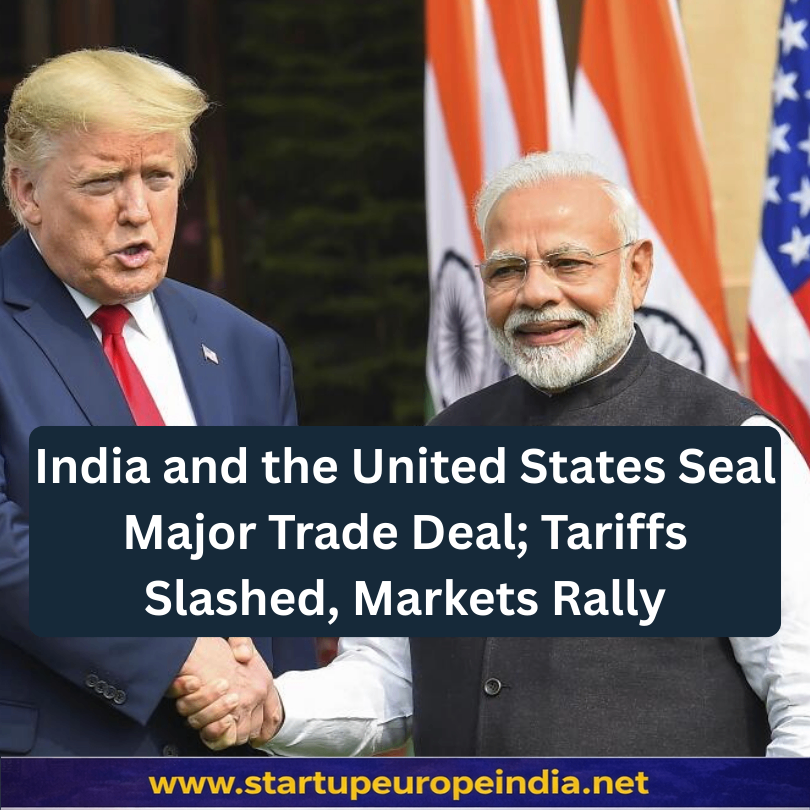
India and the United States Seal Major Trade Deal; Tariffs Slashed, Markets Rally
_<->1708724263995_9Y10OskXA8FdggLg.jpeg?w=3840&q=75)
Sarah J
Posted on Tue, Feb 3, 2026
Share the article with your network



In a significant development on February 3, 2026, India and the United States announced a major bilateral trade agreement aimed at resetting trade relations that had been strained over the past year.
The announcement came after a telephone conversation between Prime Minister Narendra Modi and U.S. President Donald Trump, with both leaders describing the pact as a breakthrough in economic cooperation and an important step toward strengthening ties between the world’s two largest democracies.
At the heart of the agreement is a sharp reduction in reciprocal tariffs on Indian goods entering the U.S. market. Washington has agreed to cut tariffs from previous levels- which reached an effective 50 % after punitive levies linked to India’s purchase of Russian crude -down to around 18 % for a broad basket of Indian products.
This move is expected to improve cost competitiveness for Indian exporters and restore price parity with competitors such as Thailand, Indonesia and Bangladesh.
In return, India is set to reduce or eliminate tariffs and non-tariff barriers on certain U.S. goods, with multiple reports indicating a move toward zero duty on several categories, opening Indian markets to U.S agricultural products, technology, energy and manufactured items.
The deal also involves broader commitments on energy sourcing, with India signalling a reduction in Russian oil purchases and increased imports from the U.S. and other partners.
The agreement effectively reverses the sharp tariff escalation of August 2025, when Washington imposed punitive levies that had significantly raised export costs for Indian goods and triggered market uncertainty. Sectors such as textiles, engineering goods, auto components, gems and jewellery and leather among others had seen order volumes decline due to heightened duties. Experts believe the tariff reset will provide relief to these industries and support a rebound in export volumes in 2026.
Market and Economic Impact
The trade announcement triggered an immediate positive response in Indian financial markets. The rupee strengthened sharply, marking its largest single-day gain in over seven years against the U.S. dollar, while benchmark indices surged, with the Nifty 50 and BSE Sensex both posting strong gains. Investor confidence was boosted by the removal of trade uncertainty after months of tariff volatility.
Trade bodies and industry associations welcomed the reset. The Engineering Export Promotion Council (EEPC India) highlighted that lower tariffs will enhance competitiveness, especially in engineering export segments. Exporters of rice and other agricultural commodities also expressed optimism about improved market access and shipment prospects under the new tariff framework.
Government Reactions and Commentary
Senior Indian leaders framed the agreement as a historic achievement. Commerce Minister Piyush Goyal described the pact as a “landmark trade agreement” between two fair-trading democracies expected to benefit farmers, MSMEs, entrepreneurs, skilled workers and exporters across sectors. External Affairs Minister S Jaishankar noted that the deal will stimulate jobs, growth and innovation, reinforcing India’s “Make in India for the world” agenda.
Finance Minister Nirmala Sitharaman also welcomed the tariff cut as “good news for #MadeInIndia products,” thanking both strategic partners for the development. Leaders across India’s political spectrum, including state officials, highlighted the potential economic gains, though some opposition voices have sought greater transparency on the terms and long-term implications of the pact.
Key Features of the Trade Deal
- Reduced U.S. tariffs: Indian exports to the U.S. now face an 18 % tariff rate, down from previous levels that included punitive levies.
- Improved market access: India is expected to reduce tariffs and non-tariff barriers on several U.S. goods, including agriculture and energy products, enhancing bilateral trade flows.
- Energy and sourcing commitments: India has signalled a shift away from heavy reliance on Russian oil, pledging increased purchases from the U.S. and other suppliers.
- Broader cooperation: The agreement lays the groundwork for deeper economic engagement across sectors such as technology, defence, agriculture and services, and may serve as a precursor to a more comprehensive future trade pact.
The India-U.S. trade deal of February 2026 represents one of the most consequential developments in bilateral economic relations in recent years recalibrating tariff structures, restoring investor confidence and charting a path for stronger long-term cooperation between two of the world’s fastest-growing major economies.
Join SEINET — the digital partnership ecosystem for tech businesses and leaders in EU-UK and India.
Start with a verified community, and unlock access to the exclusive Leaders Network for qualified founders and decision-makers. Build trusted partnerships and collaborate efficiently across markets www.startupeuropeindia.net
You may also like
Sarah J
Wed, May 27, 2026
The European Commission's New Merger Guidelines: What Has Changed and Why It Matters

Sarah J
Fri, May 22, 2026
Andhra Pradesh Is Competing With Tamil Nadu's Manufacturing With Faster Processing

Sarah J
Fri, May 22, 2026
GOOGLE I/O 2026: EVERYTHING ANNOUNCED, EXPLAINED